
Roofing Website Design: 6 Examples and What Makes Them Work

Cary Byrd // Founder of CinchLocal
A roofing website earns work by being findable for the searches homeowners actually make, then credible enough to be called. Most are judged on neither. They are judged on whether the owner likes the photo on the homepage.
Below are six roofing websites worth studying and four we built ourselves, examined on structure rather than styling — then the eight checks that decide whether a site can compete at all. If you would rather start with the full inspection, the free 40-point roofing website checklist covers everything here and more.
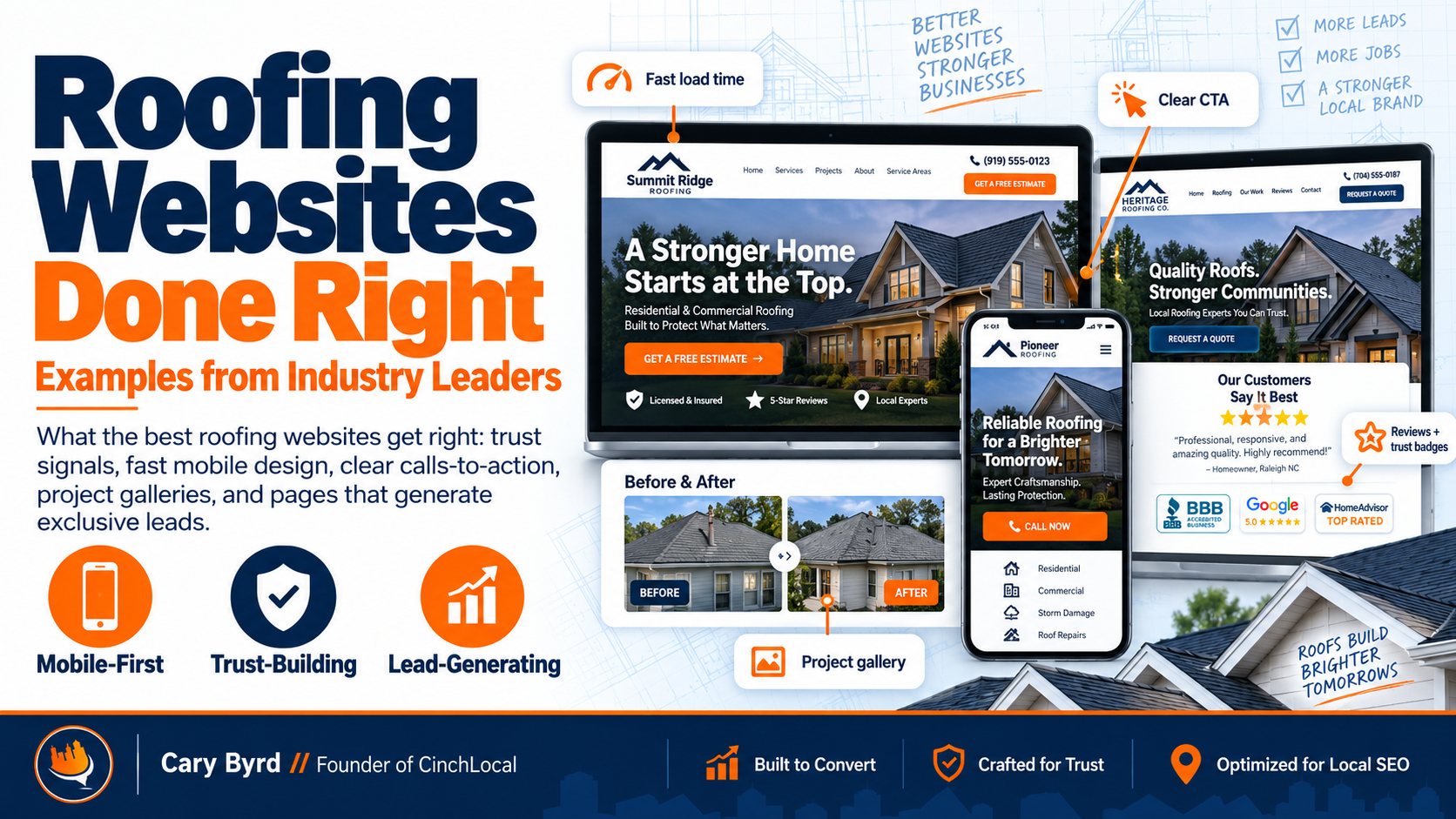
6 Roofing Website Examples Worth Studying
Most roofing website examples you find online are judged on the wrong thing. Someone lists twenty sites, calls them beautiful, and moves on. Nobody asks the only question that matters to a contractor: does it produce work?
We look at roofing websites for a living. We build them, and we audit competitors' sites before taking a client on. Six come up repeatedly, and they have almost nothing in common visually. One uses a cartoon mascot. One is austere and corporate. What they share is structural.
All County Exteriors
Clean navigation and a phone number parked in the header where a homeowner expects it. The above-the-fold message speaks to a problem rather than describing the company, service categories are organized the way a customer thinks instead of the way a contractor does, and trust badges sit where they build credibility rather than at the bottom of a page nobody reaches.
What to copy: put your phone number in the header, and write your hero line about the visitor's problem instead of your company's history.
Hippo Roofing
A cartoon mascot that makes the brand instantly recognizable in a market where every competitor uses the same stock photo of a shingle. Their interactive before-and-after slider does something static photos cannot — it shows change happening. A service area map connects visitors through to city-specific pages, and owner-featured video gives homeowners a face before they ever call.
What to copy: the before-and-after slider. It is the highest-impact element on this list, and most roofing websites do not have one.
Team Roofing
The best project gallery in the industry, and it earns that by being filterable. Visitors sort completed work by project type and location, which means a homeowner with a tile roof in a specific suburb can find a tile roof in that suburb. Embedded video testimonials and consistent staff photography do the rest.
What to copy: let people filter your gallery. An unfiltered wall of fifty roofs is a wall of fifty roofs.
Infinity Roofing & Siding
A numbered homepage that walks visitors through content in sequence rather than hoping they scroll. Dropdown menus carry image previews, an interactive service area map connects to city pages, and manufacturer certifications appear early enough to matter.
What to copy: the sequencing. Decide the order you want a visitor to learn things, then build the page in that order.
GAF
A manufacturer rather than a contractor, but the lessons transfer. Their contractor locator, shingle visualization tools, and content organized by audience type show what happens when a company maps content to different customer journeys instead of writing one page for everyone.
What to copy: the visualization tools. Homeowners buy roofs with their eyes, and anything that helps them picture the finished result shortens the decision.
Houston Roofing & Construction
Emergency contact information sits front and center, which is exactly right for a company whose customers frequently discover their problem at two in the morning. Storm damage and insurance claims assistance are treated as headline services rather than footnotes, and their community involvement gives homeowners a reason to prefer them over an identical competitor.
What to copy: if you take emergency calls, say so above the fold. Do not make a panicking homeowner hunt for it.
What the Best Roofing Company Websites Have in Common
Line those six up and the visual differences stop mattering. What repeats is structure — and it is the same structure every time.
Seven patterns that repeat
Depth instead of breadth. Every one of them has separate pages for separate services. None asks a single Services page to rank for repair, replacement, storm damage, and commercial work at once. This is the difference contractors underestimate most, and it is the one that costs the most.
Geography treated as content, not a list. Where these sites name a market, they say something about it. A column of fifteen town names gives a search engine no reason to associate you with any of them. Google's own guidance on how local rankings work names relevance, distance and prominence as the three things it weighs — distance is fixed, but relevance and prominence are built, and they are built out of specific pages.
Proof at the decision point. Reviews, certifications, and warranty details appear next to the thing being decided — on the service page, beside the call to action — rather than quarantined on a testimonials page nobody visits. Reviews do double duty here — they also feed the prominence signal behind Google Map Pack rankings.
Photography of actual work. Not stock. Homeowners can tell, and the ones who cannot will still trust a real roof over a rendered one.
A phone number that behaves like one. Visible in the header, tappable on mobile, repeated at the bottom of long pages.
Content built to be scanned. Nielsen Norman Group's research on how people read online found that 79% of users scan a new page and only 16% read it word for word. Long unbroken paragraphs about your company history are not being read. Headings, short paragraphs and bolded specifics are.
One obvious next step per page. Not four competing buttons. One.
None of that is a design decision. It is architecture, which is why a roofing website can look excellent and still lose to a plainer competitor built correctly underneath.
Where most roofing contractor websites fall short
Everything on one page. One Services page covering eight services, one Areas We Serve page listing fifteen towns. The site is not too small. It is missing the pages that would make it findable.
Stock photography. A roof that is not yours, on a house that is not in your state, under a sky that is not your weather.
The city buried in the footer. If your market appears only in your address block, you have not told anyone where you work in a way that counts.
No answer to the emergency. A homeowner with water coming through a ceiling is not reading your About page.
Trust signals quarantined. Certifications and reviews on a dedicated page instead of beside the decision they are meant to support.
A contact form built for your convenience. Nine required fields, including budget. Every field you add costs you submissions, and asking a stranger for a budget before you have earned anything costs you the most.
The failure that looks like success
There is a seventh problem that hides better than the rest, because on a report it looks like a win. A roofing site can rank well, pull thousands of visits a month, and bring in almost nobody who will ever hire a roofer.
We audit sites ranking on page one nationally for searches like how to shingle a shed roof and how to install shingles on a shed. Every one of those visitors intends to do the work themselves — that is the entire premise of the search. The traffic graph looks excellent. The phone does not ring.
The same trap catches informational content that is merely off-target. A roofing company ranking first in the country for chimney flashing technique is being read by homeowners in states it does not serve, while its own city-plus-service term sits on page two — which is a roofing SEO problem, not a content problem.
Not all informational content is a trap. An article on what insurance typically pays out for hail damage attracts a homeowner who is about to file a claim and hire a roofer. An article on how to shingle a shed attracts someone who is about to visit a hardware store. Same format, opposite commercial value.
Traffic is not the goal. Traffic from people in your service area who intend to hire someone is the goal, and those two numbers can differ by an order of magnitude. If the phone is not ringing, that gap is usually the reason — and it is fixable, which is the whole basis of roofing lead generation that works.
None of these are expensive to fix. They are structural decisions that got made by default rather than on purpose. If you want the full picture of how that structure gets planned before a single page is designed, we lay it out on our roofing website design page.

How Google and AI Assistants Read a Roofing Website
Everything above describes what a good roofing website looks like to a person. This is what it looks like to a machine, and the two are less similar than most contractors assume.
Google ranks pages, not websites
This is the single most useful thing to understand about roofing website design. A site with one Services page has one page competing for every service term you sell — which in practice means competing for none of them. Eight service pages compete for eight terms. The site did not get better; it got more surface area.
The same logic governs geography. A page listing fifteen town names in a footer is one page. Fifteen market pages with real local content are fifteen chances to rank, which is why building proper local landing pages moves map pack coverage when nothing else does.
Structured data is the part almost nobody does
Schema.org publishes a RoofingContractor type — a machine-readable label that tells a crawler explicitly what the business is, what it does and where it works, rather than leaving it to infer all three from your prose.
Of the six websites above, one had it. That is roughly the industry rate, and it is why structured data is one of the few genuine advantages still available in this trade. Our guide to schema markup for local SEO covers the implementation.
Why this matters more every quarter
When a homeowner asks an AI assistant who to call for a roof leak, the assistant is reading your pages, your Google Business Profile and your reviews — the same evidence Google ranks on. There is no separate version of your website that assistants see, and no product you can buy to appear in their answers.
A site with real service pages, real market pages and structured data is one an assistant can cite with confidence. A five-page site gives it nothing to work with.
AI SEO for roofers explains what changes and what does not.

Roofing Websites We Built, and What Each One Proves
Everything above is what we look for. Here is what it looks like when we build it — four builds, four different problems solved, with the search data that shows whether it worked. Longer write-ups live in our residential roofing case study and commercial roofing case study.
Big River Roofing — Hermitage, Pennsylvania
Not the flashiest site we have built, and one of the healthiest. It ranks first for its name plus its city, which is the baseline every roofing company should hold and many do not. More importantly, the non-branded clicks come from roofing companies near me, gutter installation near me, roof repair near me free estimate, and roofers in my area. Those are people hiring.
Hermitage is a small market, and the numbers are modest by design. There is no version of a roofing website in a town that size that pulls a hundred thousand visitors, and any agency promising one is selling shed tutorials. Nearly every non-branded click is somebody in the service area looking to hire a roofer.
What it proves: a small market done properly beats a big number earned from the wrong people.
Check out the case study for Big River Roofing.
Kings Roofing & Contracting and Ryson Roofing — the same skeleton, two different skins
These two sites share an architecture and look nothing alike. One is dark, one is light. Same structure underneath: service clusters, city hubs, and service pages built beneath each city rather than a list of town names.
Kings ranks for roofing companies boise, roofing boise, roof repair boise and roof replacement boise — and now for roof replacement meridian idaho, a town where they have no office. That last one is the whole argument for city clusters, visible in the data.
What it proves: appearance and architecture are separate decisions. You can have any look you want on top of a structure that works.
Check out the case study for Kings Roofing & Contracting.
Loudoun Roofing — Leesburg, Virginia
The clearest example of geographic depth paying off. Loudoun ranks second for its brand term, and then for loudoun county roofing, leesburg roofing, roofers in leesburg va, roof repair leesburg va, and roofers ashburn. That is one company appearing for several towns, which is what a service area business needs and what an Areas We Serve list never delivers.
What it proves: a page per market, with substance on it, is how you get found in towns you do not have an address in.
Heritage Roofing — Harrison, Arkansas
A family roofing business founded in 1968, and a useful counterpoint to the trap described above. Heritage ranks locally for roofing companies harrison arkansas, roof repair rogers ar and springdale roofing. It also ranks for informational searches — what insurance typically pays out for hail damage, TPO hail damage, EPDM repair.
That informational content is doing real work, because every one of those searches is a homeowner or building owner with a damaged roof and a decision to make. Compare it to a shed tutorial and the difference is not the format. It is whether the reader has a roof problem worth money.
What it proves: informational content earns its place when it sits next to a buying decision, and wastes your money when it does not.
How to Judge Your Own Roofing Website
Looking at other people's roofing websites is useful right up to the point where you have to decide what to do about your own. That is harder, because you cannot see your site the way a stranger does. You already know where everything is.
So use a test instead of an opinion.
Open your homepage on your phone and start a timer. In three seconds, can a stranger tell who to call, where you work, what you do, and what to do next? Most roofing websites fail on the second one — the city sits in the footer, if it appears at all.
Then try to find the page on your site about the single service you most want more of. Metal roofs, commercial flat roofs, whatever it is. If that page does not exist, or it is a paragraph on a shared Services page, you have found the reason you are not ranking for it.
Then search your own company name plus a town you serve but have no office in. Look at who comes up instead of you.
Then open Search Console and read the queries you actually rank for. If most of them start with how to, you have the seventh problem.
If you want the thorough version, we built a free 40-point roofing website inspection that covers the same ground — services, markets, trust signals, technical structure, and conversion paths — and hands you a punch list at the end. It takes about ten minutes and costs nothing.
How to Judge Your Own Roofing Website
Eight checks, in rough order of impact. You can run all of them yourself in about five minutes — the tool below scores it and tells you which gap to close first.
For load speed, Google PageSpeed Insights gives you the real number rather than an impression. Everything else is a matter of counting and looking. And if you want the longer version, our page on the most searched roofing keywordsshows what homeowners actually type — compare that list against your own page count and the gap becomes obvious.
The same eight structural checks, applied to your site. Nothing is submitted and no email is required.
Structure decides what you can rank for. Design decides whether they call.
Get the full 40-point checkA self-assessment, not an audit. This reflects what you tick, not what Google sees — it cannot check your rankings, your competitors or your load speed for you. The eight checks are the same ones applied to the six websites above, chosen because each one determines what a site is able to rank for rather than how it looks. A real audit is what the strategy call is for.
Questions About Roofing Website Examples
What makes a good roofing website?
A good roofing website is findable for the searches homeowners make and credible enough that they call. Structurally that means a page for every service you sell and every town you serve, a phone number visible without scrolling, real photos of your own completed jobs, reviews on the page, load times under two seconds on mobile, and schema markup. Design decides the second half — whether they call. Structure decides whether they ever arrive.
How much does roofing website design cost?
Freelancers and local designers typically charge $1,000 to $3,000 for a build with limited SEO. Specialized roofing agencies run $3,000 to $9,000 and up, usually with lead-generation structure included. The figure that matters more than the build cost is what happens afterward — a $2,000 site with five pages costs more in missed work over three years than the difference in price.
How many pages should a roofing website have?
More than fifteen, not counting blog posts. One page per service you sell, one per market you want work in, plus home, about, contact, reviews and a gallery. A five-page roofing website can rank for the company name and very little else, because there is nothing on it that matches a specific search.
What are the best roofing company websites?
The ones worth studying are not necessarily the best-looking. All County Exteriors leads with a factual trust signal above the fold. Team Roofing filters its project gallery by type and location. Infinity Roofing runs genuine city pages rather than a list of town names. Houston Roofing & Construction is built around the emergency moment its customer actually arrives in. Each does one structural thing well that most roofing contractors skip.
Do I need a custom roofing website or is a template fine?
A template is fine if it lets you build unlimited pages with proper heading structure and schema markup. Most do not — they cap you at a handful of pages and produce a site that cannot compete beyond your company name. The question is not custom versus template. It is whether the platform lets you build the page hierarchy the searches require.
How long does it take to build a roofing website?
Four to eight weeks for a professional build: discovery, design, development, content, testing and launch. Ranking takes longer. A new site can earn impressions within weeks, but map pack position and geographic coverage build over months. Anyone promising both in thirty days is describing paid ads.
Does my roofing website affect my Google Maps ranking?
Yes, substantially. Google names relevance, distance and prominence as its local ranking factors, and your website is where relevance is built. Real pages about specific services in specific towns are what connect your business to markets beyond your own address. A weak website puts a ceiling on map pack coverage that no amount of profile optimization can lift.
Should my roofing website have a blog?
Only if it answers questions homeowners actually ask. A blog of generic roofing articles does nothing. A blog that answers what a roof replacement costs in your area, how the insurance claim process works, or which materials suit your local climate earns links, gets cited by AI assistants, and feeds your service pages. Quality over cadence.
What is schema markup and does my roofing site need it?
Schema markup is structured data in your page code that tells search engines explicitly what your business is, what it does and where — rather than leaving them to infer it. Schema.org publishes a RoofingContractor type specifically. Of the six websites reviewed above, one had it. That is roughly the industry rate, which makes it one of the few genuine competitive advantages still available.
How do I know if my roofing website is working?
Three numbers. How many pages earn impressions in Google Search Console — if it is only your homepage, structure is the problem. What percentage of your service area shows you in the top three of the map pack. And how many calls and form submissions arrive monthly against what you spend. Traffic alone tells you nothing; a site with visitors and no calls has a conversion problem, not a visibility one.
This is paragraph text. Click it or hit the Manage Text button to change the font, color, size, format, and more. To set up site-wide paragraph and title styles, go to Site Theme.
Want Us to Uncover Hidden 'Footprint Gaps' And Critical Blind Spots That’s Quietly Draining Calls, Jobs, and Profits?
Simply Fill Out The Form Below:
What If You Could Stop Wasting $30K+ a Year on Dead-End Marketing - And Finally Become the Go-To Roofer in Your City?
Other Helpful Articles You Might Enjoy