

Essential Elements for a High-Converting Roofing Landing Page

Cary Byrd // Founder of CinchLocal
Local Landing Pages for Roofers:
How to Rank in Every City You Serve
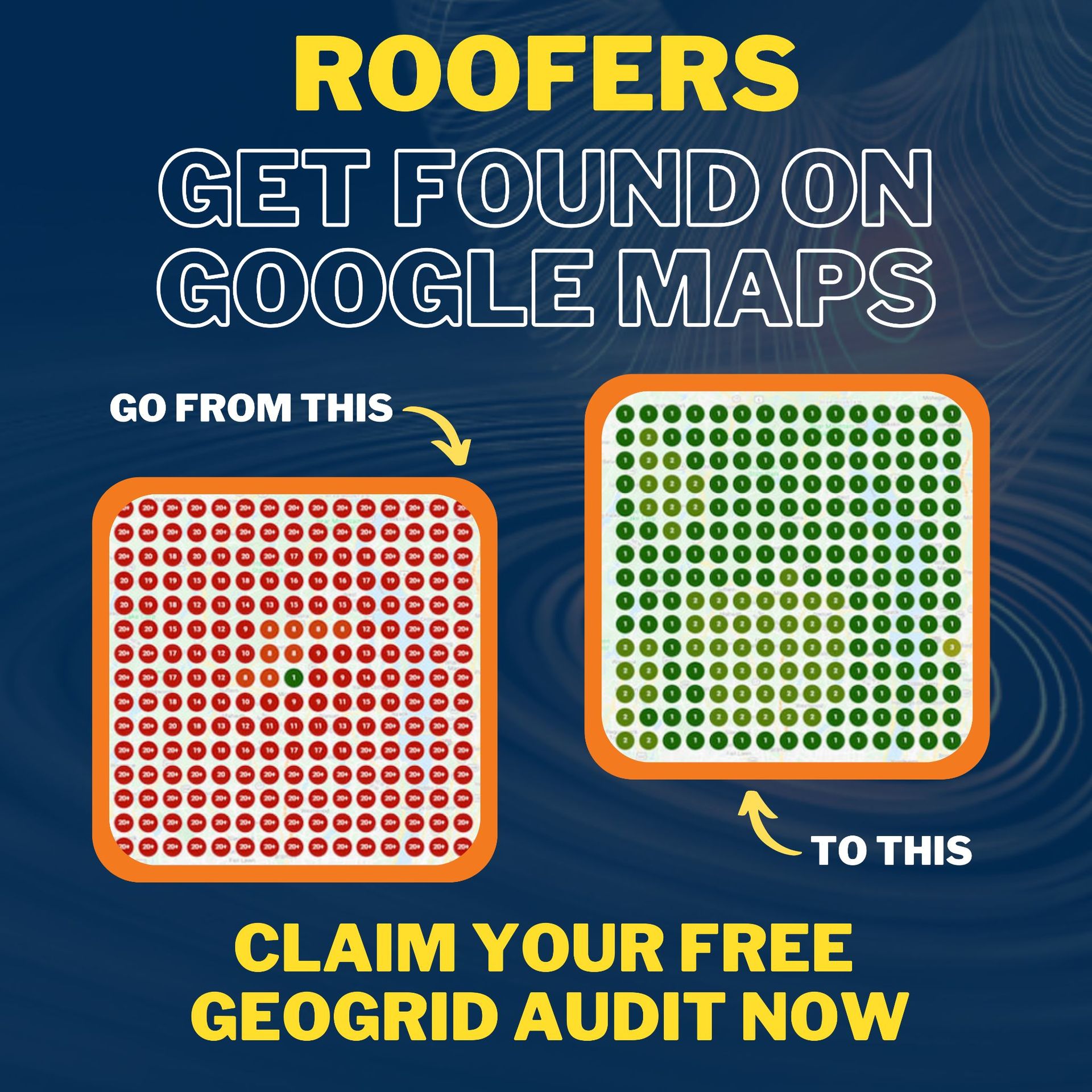
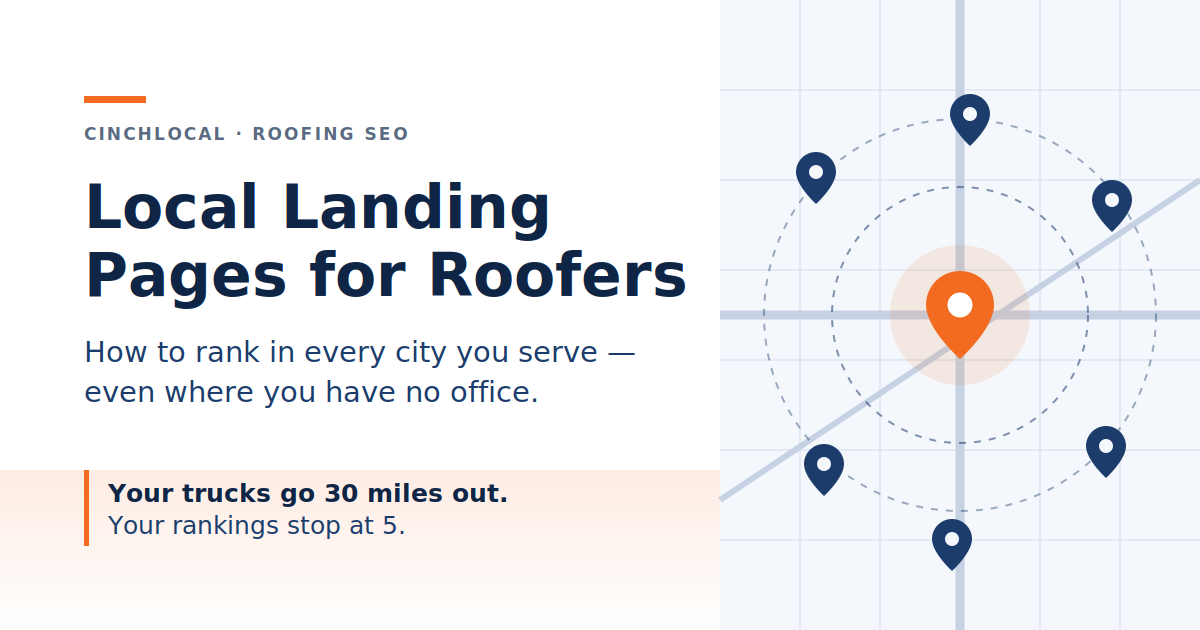
Your service trucks cover a thirty-mile radius. Your Google rankings probably extend about five miles from your office. That gap is where your most profitable jobs quietly go to competitors — and closing it is what local landing pages are for.
The short version:
- Build one page per city you actually serve — not per city you'd like to serve
- Use a clean URL like
yourcompany.com/roofing-plano - Write genuinely unique content for each — local roof types, storm history, permit rules
- Add LocalBusiness schema naming the service area explicitly
- Include proof from that city — real project photos, real testimonials
- Link to them from your main service pages, not just the footer
- Start with five to ten cities, not fifty
Score One of Your Own City Pages
Everything above describes what a city page needs. This tells you what yours actually has.
Open one of your city pages in another tab and answer twelve questions while you look at it. Every question can be answered from the page itself — nothing requires opening the code. You will get a score out of 100, a band, and a line-by-line breakdown of what passed and what did not. No email, no gate.
One warning before you start: run it on the city page you are proudest of. If that one comes back thin, the others will be worse.
Open one of your city pages in another tab and answer as you look at it. Twelve questions, about ninety seconds.
Why you can't crack the Map Pack in a town where you have no office
Google ranks local results on three factors: relevance, distance, and prominence. Distance is the one you can't argue with. If your office is in Fort Worth and someone in Plano searches "roof repair near me," the Map Pack is going to favor roofers with a Plano address. No amount of optimization changes tha
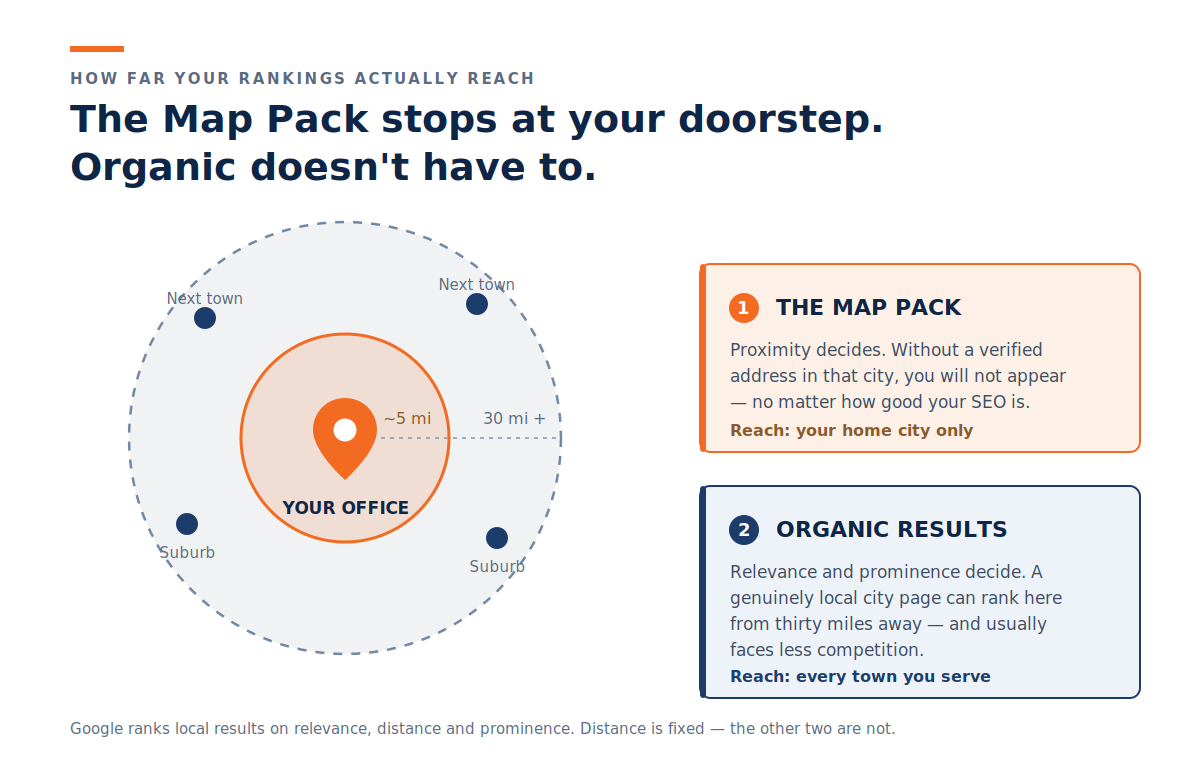
But the Map Pack is only the top of the page. Below it sit the organic results — and those aren't governed by proximity in the same way. A well-built city page can rank there for "roofing contractor in Plano" without you having a single square foot of Plano real estate. Often with less competition than the Map Pack, because most roofers either don't build these pages or build them badly.
A city page is not a location page
This distinction matters more than it sounds. A location page is for a physical place customers visit — an office, a showroom, a yard. A city page, sometimes called a service area page, is for a town you drive to but don't operate from.
Roofing is almost entirely the second kind. You're a service area business. Your customers never come to you. That means your city pages need to prove operational presence rather than describe a building, and it changes what belongs on them.
The on-page blueprint
URL, title tag, and meta description
Keep the URL clean and readable: yourcompany.com/roofing-plano
beats yourcompany.com/service-areas/locations/tx/plano-roofing-services
. Shorter URLs get clicked more and are easier for Google to parse.
Title tags should carry city, service, and brand — "Roof Repair in Plano, TX | Your Company" — and stay between 55 and 70 characters so they don't truncate in results. Meta descriptions run about 150 to 160 characters and should give someone a concrete reason to click rather than restating the title.
Headings and page structure
Your H1 states the purpose plainly: "Your Trusted Roofing Contractor in Plano, TX." The target keyword should appear in the URL, the title tag, the H1, and within the first hundred words of the body. After that, stop — you're signalling relevance, not stuffing.
Include your Name, Address, and Phone number on the page, and make sure they match your Google Business Profile and every directory listing exactly. Inconsistent NAP data is one of the most common and most invisible causes of suppressed local rankings, particularly for roofers who've moved offices or changed numbers.
Embed a Google Map showing your service area rather than dropping a fake pin at an address you don't occupy. The map reinforces geographic context; a fake address is a violation waiting to be reported.
The part everyone gets wrong: making each page genuinely different
The failure mode is always the same. Someone writes one page, duplicates it fifteen times, swaps the city name, and publishes. Google has a name for that — doorway pages — and its spam policies address it directly. The penalty doesn't stop at the city pages either; it can drag down your whole site.
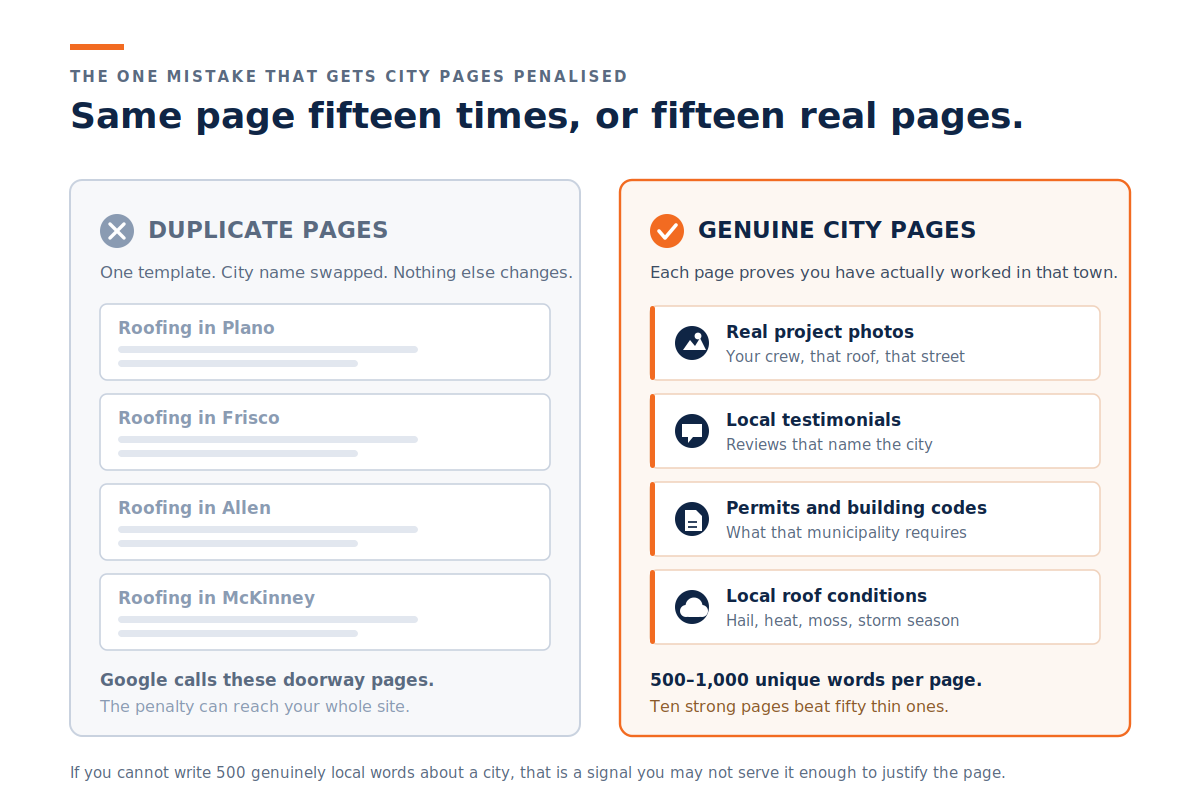
Genuinely unique means writing about the actual place:
- Local roof conditions. Hail-resistant shingles for a Texas storm belt town. Moss treatment where it's humid. Heat-reflective systems where summers are brutal.
- A real project from that city. The problem, what you did, the outcome, with photos. One mini case study is worth a thousand words of generic service copy.
- Local permits and codes. What a homeowner in that municipality actually has to deal with. Almost nobody covers this, and it demonstrates you've worked there.
- Testimonials from that city. Names and neighborhoods where you have permission. A review that says "Plano" is a local relevance signal; a five-star rating with no text isn't.
- Community connection. Sponsored a team, joined the chamber, worked a storm cleanup — say so. It separates you from out-of-town lead-gen sites.
Aim for 500 to 1,000 words of substance per page. Below that you're in thin-content territory regardless of how unique the words are.
Images and video
Use photos of your own crews on real roofs in that city, not stock. Name the files descriptively — roof-replacement-plano-tx.jpg
— and write alt text that describes the image rather than repeating keywords. Video testimonials from local customers do more for trust than any amount of copy, and they're the kind of people-first content Google's guidelines explicitly reward.
Technical requirements
Implement LocalBusiness schema on every city page, with the service area named explicitly. This is how search engines — and increasingly, AI answer engines — parse where you operate without inferring it. Validate it before you publish; broken schema is worse than no schema. We cover the implementation detail in our guide to schema markup for local SEO.
Every city page belongs in your XML sitemap. Link to each one from your main service pages and from a "Service Areas" section in your navigation — not buried in the footer. Internal links are how authority reaches those pages, and most roofing sites get this exactly backwards.
Mobile matters more here than almost anywhere else. Local searches skew heavily to phones, and Google indexes mobile-first. A city page that loads slowly on a phone is a city page that doesn't rank.
How many pages should you build?
Start with five to ten. Pick the cities where you already get jobs, or where the housing stock and population justify the effort. Five strong pages that rank will out-earn fifty thin ones that don't — and the fifty carry real penalty risk.
Once you have a template that works and a process for producing genuinely local content, scale deliberately. Never create a page for a city you don't actually serve.
Measuring whether it's working
- Rank tracking by city or zip code — sitewide averages hide everything that matters here
- Unique call tracking numbers per city page — the only reliable way to attribute leads
- Google Search Console impressions and clicks per page — shows which queries each city page is actually catching
- Traffic by geography — confirms you're reaching the towns you're targeting
- Google Business Profile insights — calls, direction requests, and website clicks
Expect movement on less competitive terms within three to six months. Competitive city terms take six to twelve. Anyone promising faster is selling something.
Where this fits
City pages are one piece of a larger system. They handle organic reach into towns where proximity works against you. Google Maps SEO handles the Map Pack in the areas where you can win it. Local citations and consistent NAP data support both. Together they're what we call footprint expansion — and you can see what it produces in our residential roofing SEO case study.
If building out unique content for a dozen cities sounds like more than you want to take on, that's the normal reaction. It's the single most labor-intensive part of roofing SEO, and it's why most contractors skip it — which is exactly why it still works.
Frequently Asked Questions
Want Us to Uncover Hidden 'Footprint Gaps' And Critical Blind Spots That’s Quietly Draining Calls, Jobs, and Profits?
Simply Fill Out The Form Below:
What If You Could Stop Wasting $30K+ a Year on Dead-End Marketing - And Finally Become the Go-To Roofer in Your City?
Other Helpful Articles You Might Enjoy