
Beginner's Guide to Roofers Google Maps Optimization

Cary Byrd // Founder of CinchLocal
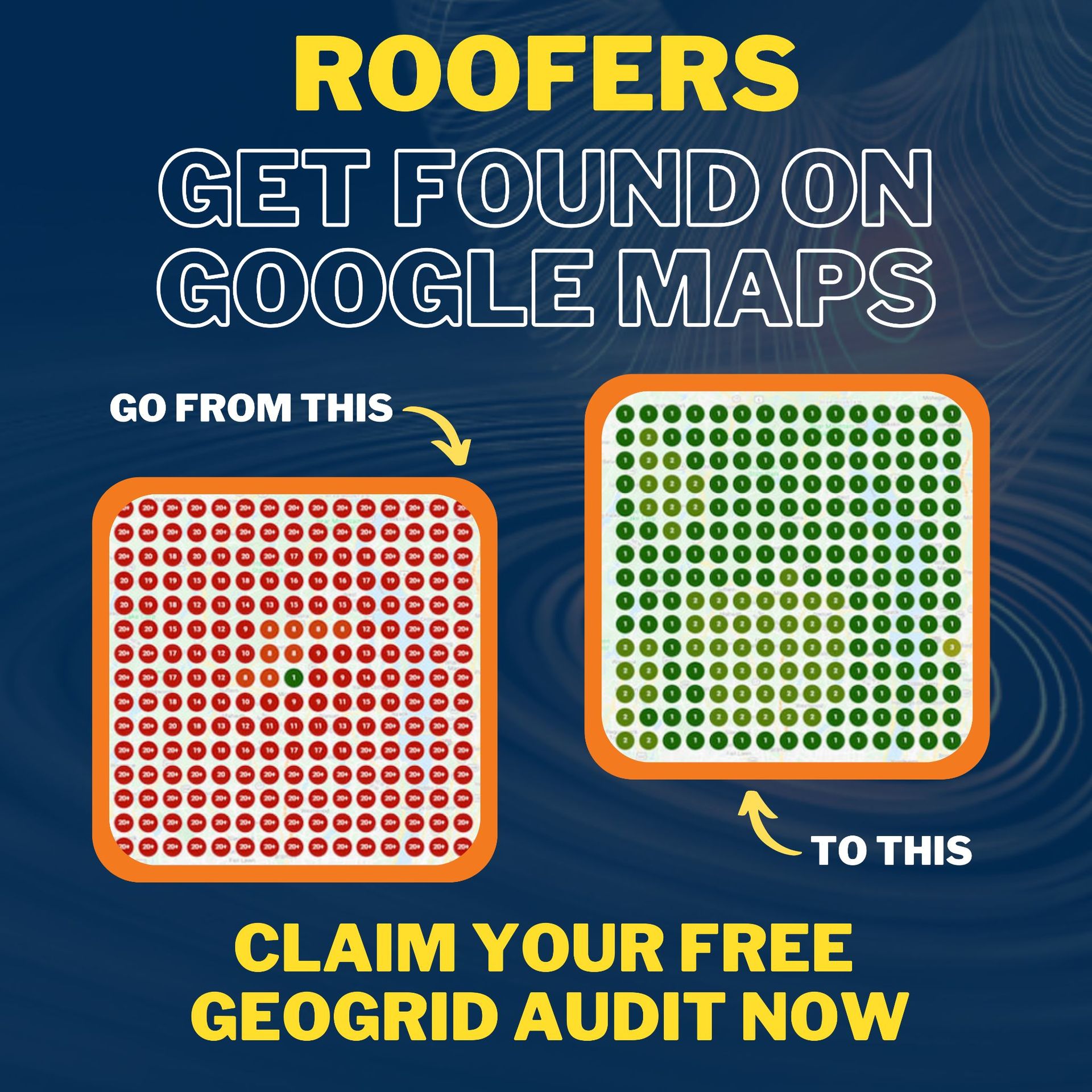
Get Your Roofing Company Higher on Google Maps
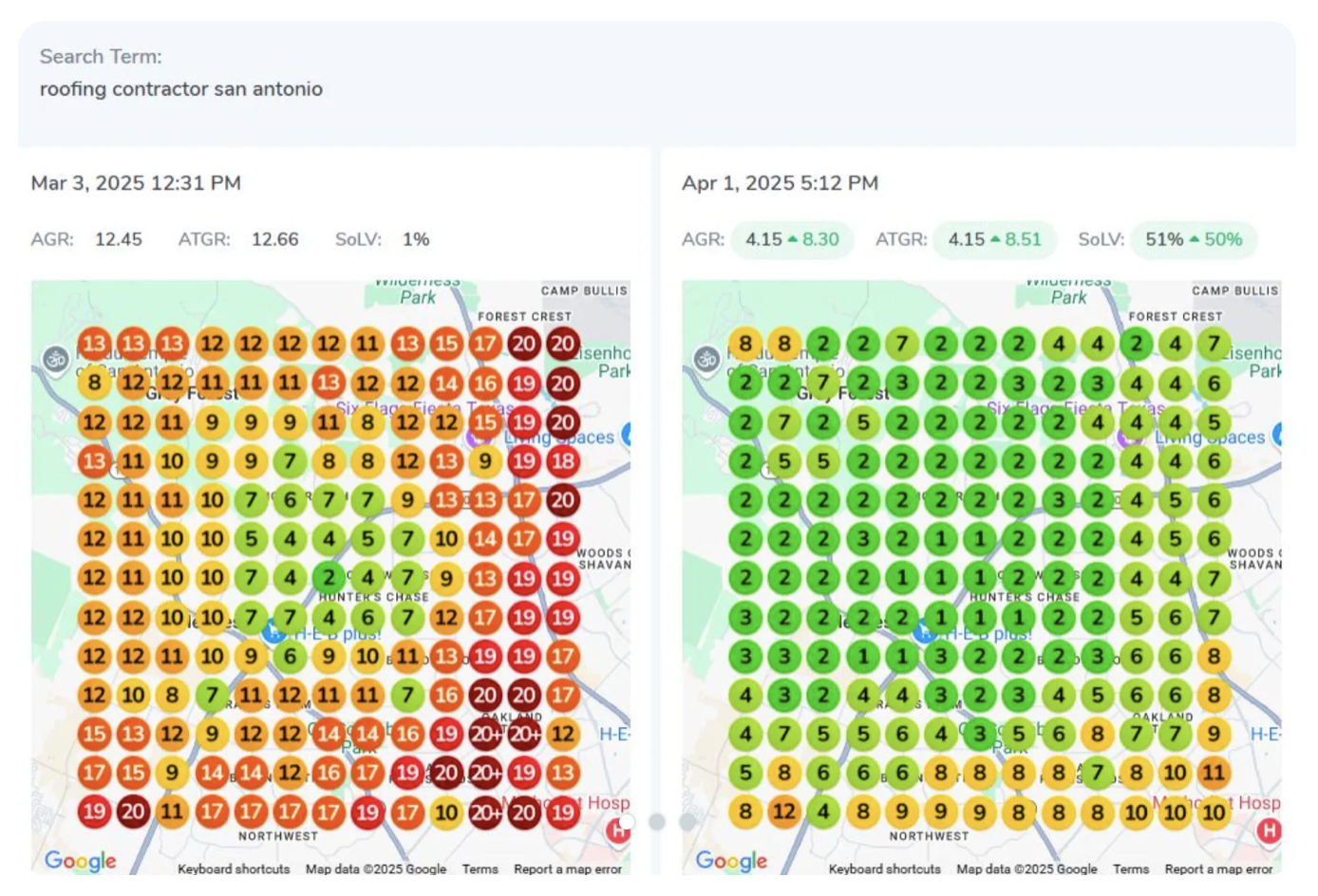
To improve your Google Maps visibility, start with four actions: set Roofing Contractor as your primary Google Business Profile category, keep your name, address, and phone number identical everywhere online, earn new customer reviews every month, and publish useful pages for the cities you serve. These steps improve the relevance, trust, and prominence Google uses to rank local roofers.
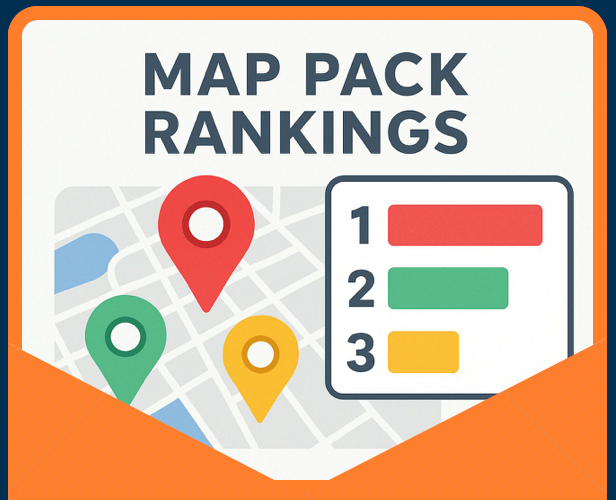
The prize is substantial. The three Google Maps results shown for local service searches receive more than 70% of clicks, while the first result earns roughly one-third. For a roofing company, a stronger map pack position means more calls for roof repairs, replacements, inspections, and storm-damage work - without paying for every click.
Roofing marketing and local SEO support should not be a mystery or a one-time cleanup. Your profile needs accurate category and service details, steady review activity, consistent citations, and location-focused website content that proves where and what you serve.
This guide breaks down the practical work behind roofers Google Maps optimization, including what you can fix in the first 90 days and what takes months to build. Avoid shortcuts such as virtual office addresses, bulk citation blasts, review spikes, and copied city pages; they can weaken trust or put your profile at risk.
I am Cary Byrd, founder of CinchLocal, where I lead strategies for roofers Google Maps optimization, roofing SEO, web design, and lead generation. I have spent years building and managing search-focused digital marketing systems, and the next sections will show you how to apply that work to your roofing business.
How Google Maps Algorithm Ranks Roofing Contractors
Google's local algorithm determines rankings by analyzing three core factors: relevance, distance, and prominence. These variables operate together to match a property owner's specific search query with the most reliable, geographically appropriate local contractor.
For contractors aiming to scale inbound leads, understanding the technical application of Google Maps local SEO for roofers is essential. When a homeowner searches for "metal roof replacement" or "hail damage repair near me," Google scans verified business listings within its index. The algorithm assesses how accurately a profile matches the requested service, the physical distance between the user and the contractor, and the overall digital market authority of the company.
Ranking Factor Breakdown: Relevance, Distance, and Prominence
To optimize effectively, you must understand how each factor functions in local home service searches:
- Relevance: The degree to which your business listing matches what the user is searching for. Google determines this by reading your primary category, secondary categories, service lists, on-page website copy, and local schema markup.
- Distance: The physical proximity of your business address (or defined service radius) to the user's location at the time of their search. Proximity acts as a natural algorithmic boundary, meaning you cannot rank everywhere without supporting digital footprint assets.
- Prominence: The metric measuring your company's digital reputation, offline authority, and search engine trust. Prominence is built through steady review generation, structured directory citations, local news mentions, backlinks, and active customer engagement.
Recognizing the Google local 3-pack importance clarifies why simply having a verified business listing is insufficient. Relevance and distance get your business evaluated, but prominence establishes which contractor wins top placement.
Why Prominence Decides Top-3 Positions in Roofers Google Maps Optimization
Prominence serves as the decisive tiebreaker when competing contractors exhibit equal geographic relevance and proximity. In competitive metro markets across Ohio, Tennessee, Georgia, California, and throughout the USA, multiple licensed roofers often share identical categories and overlapping service zones.
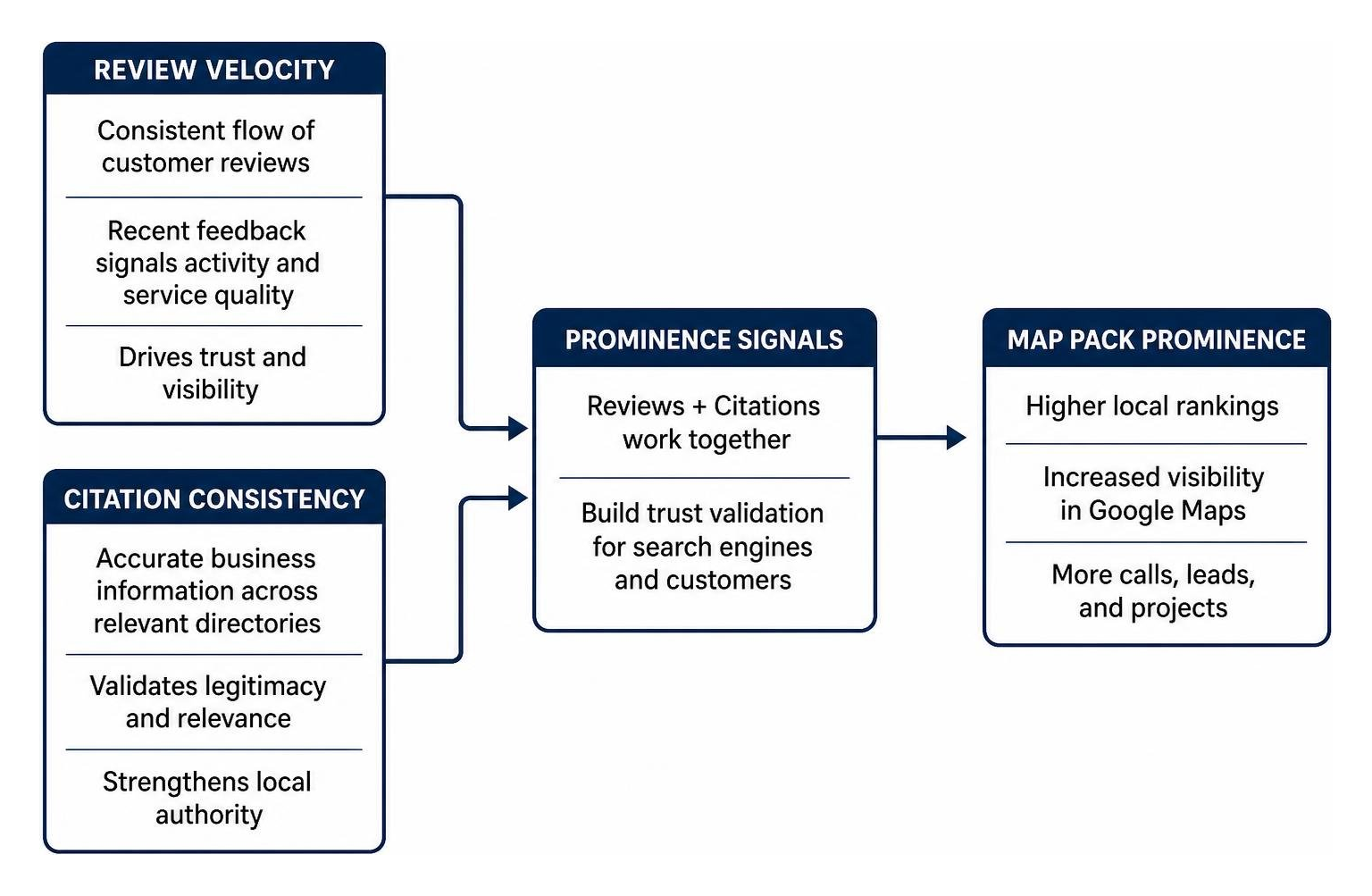
When Google decides whether to place your roofing company in position 1 or push it down to position 4, it evaluates prominence signals:
A business with 147 reviews that has not received a single new review in six months will lose ground to a competitor with 63 reviews that adds four new reviews every single month. In high-density markets, prominence signals dictate long-term local pack dominance. Check our verified client results to see how prominence-driven campaigns create measurable ranking shifts for contractors.
Step-by-Step Roofers Google Maps Optimization for Your Business Profile
Optimizing your Google Business Profile (GBP) requires precise configuration rather than casual guesswork. Following our established Google My Business optimization for roofing companies methodology ensures your profile operates at peak technical efficiency while adhering strictly to Google Business Profile guidelines.
Selecting Primary and Secondary Categories Accurately
The single most critical field on your profile is the primary category. You must select Roofing Contractor as your primary category.
A common pitfall occurs when multi-trade contractors select General Contractor as their primary designation. While this broad categorization seems practical for builders, it structurally prevents your profile from appearing in high-intent searches such as "emergency roof repair" or "roof leak inspection."

Secondary categories expand your query footprint without compromising your primary trade authority. Include these secondary classifications where applicable:
- Siding Contractor
- Gutter Cleaning Service
- Waterproofing Service
- Construction Company
- Building Restoration Service
Securing correct categorization during initial Google Business Profile verification for roofing contractors avoids disruptive category edits that can trigger secondary video reverifications.
Optimizing Service Descriptions, Visual Assets, and Profile Updates
Under each category in your profile dashboard, complete the services menu with exact, localized descriptions:
Write individual descriptions (up to 150 words) for services such as commercial flat roofing, TPO membrane installation, skylight replacement, and emergency tarping.
Next, establish a visual media baseline. Maintain at least 20 high-resolution photos displaying:
- Field Operations: Crew members wearing branded safety gear on active job sites.
- Completed Work: High-angle, clear shots of completed residential and commercial roofs.
- Fleet & Equipment: Branded trucks, dump trailers, and material setups outside your physical office.
- Office & Team: Authentic exterior office signage and professional staff portraits.
Upload 2 to 3 new field photos monthly and publish weekly Google Business Profile updates highlighting completed local projects to align your listing with current technical standards.
Building Prominence: Review Velocity, Citations, and Service Area Architecture
Prominence is the trust validation layer of roofers Google Maps optimization. Securing top local positions requires a structured system combining continuous customer feedback, directory validation, and website geo-architecture. You can also explore practical video breakdowns of Hyperlocal SEO strategies to see how contractors implement these multi-channel signals in competitive territories.
Review our detailed blueprint on map pack mastery for roofing companies to understand how off-page authority directly drives GBP positioning.
Review Velocity and Review Cadence in Roofers Google Maps Optimization
Review velocity—the consistent rate at which you acquire customer reviews over time—outweighs your total historical review count. Google prioritizes recent feedback to evaluate whether a company is active, operational, and maintaining service quality.
To establish steady review velocity without risking algorithmic filtering:
- Implement Post-Job SMS Automation: Send an automated SMS review link 24 to 48 hours after project completion through your CRM.
- Maintain Quick Responses: Respond to 100% of incoming customer reviews within 24 hours. A company with 60 reviews and a 100% response rate consistently outperforms a competitor with 80 reviews and a 25% response rate.
- Avoid Bulk Review Surges: Never send 50 review requests in a single afternoon after months of zero activity. Velocity anomalies can trigger spam filters that remove legitimate reviews or suppress your listing.
- Avoid Review Gating: Never pre-screen customers with thumbs-up/thumbs-down surveys before routing them to Google. This violates platform guidelines.
Transforming customer satisfaction into sustainable local pack positions is covered further in our resource on converting from Google Maps to more leads.
Citation Quality Tiers and Strict NAP Consistency
Name, Address, and Phone Number (NAP) consistency validates your legitimacy across the web. Discrepancies as minor as "100 Industrial Parkway, Suite A" versus "100 Industrial Pkwy #A" create data confusion that weakens search engine confidence.
| Citation Tier | Target Directories & Data Providers | Strategic Purpose |
|---|---|---|
| Tier 1: Core Platforms | Google, Apple Maps, Bing Places, Yelp, BBB | Establishes baseline search authority and direct referral channels. |
| Tier 2: Major Data Aggregators | Data Axle, Neustar Localeze, Foursquare | Distributes consistent business NAP data downstream to hundreds of mapping networks. |
| Tier 3: Trade & Local Directories | Angi, HomeAdvisor, Chamber of Commerce, NRCA | Delivers industry relevance and geographically anchored local backlinks. |
Build citations steadily at a rate of 5 to 10 per week. Uploading 60 new directory citations in a single week looks unnatural to automated quality systems and risks listing devaluation.
Scaling Beyond Your City with Targeted Service Area Pages
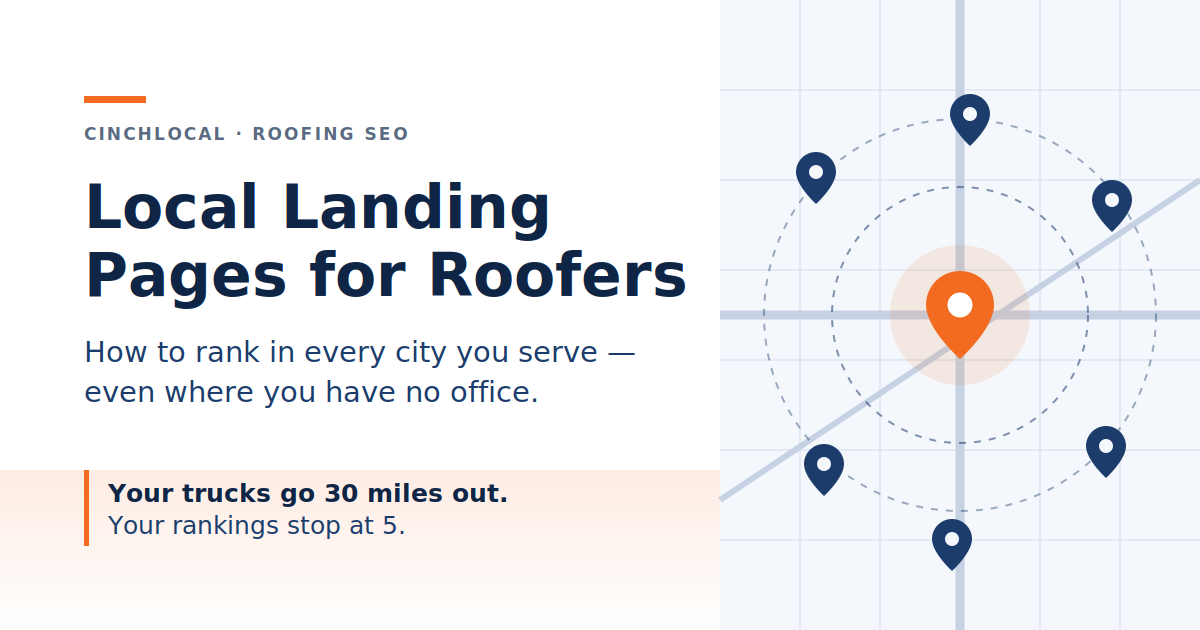
Your Google Business Profile address anchors your primary ranking power. However, setting broad radius boundaries inside GBP does not automatically rank your profile across those surrounding cities without supporting website authority.
To establish authentic geographic relevance in neighboring municipalities, deploy dedicated service area landing pages built with localized schema markup:
When building city landing pages, adhere to these technical standards:
- Original Case Studies: Document actual roofing projects completed in that municipality, including neighborhood names, materials used, and local code considerations.
- Localized Testimonials: Feature customer reviews specifically from residents of that service city.
- Structured Data Integration:
Implement LocalBusiness structured data
utilizing the
areaServedproperty to declare target coverage areas. - Internal Linking: Link localized blog content and surrounding city pages back to your primary service silos.
For an actionable execution plan on cross-city local search rankings, read our guide on how to nail your roofing company's map pack rankings.
90-Day Quick Wins vs. 6-Month Compounding Roadmap
Ranking at the top of Google Maps requires a phased strategy that balances immediate baseline relevance fixes with compounding prominence assets. Explore our comprehensive guide to using Google Maps for roofing for an expanded strategic overview.
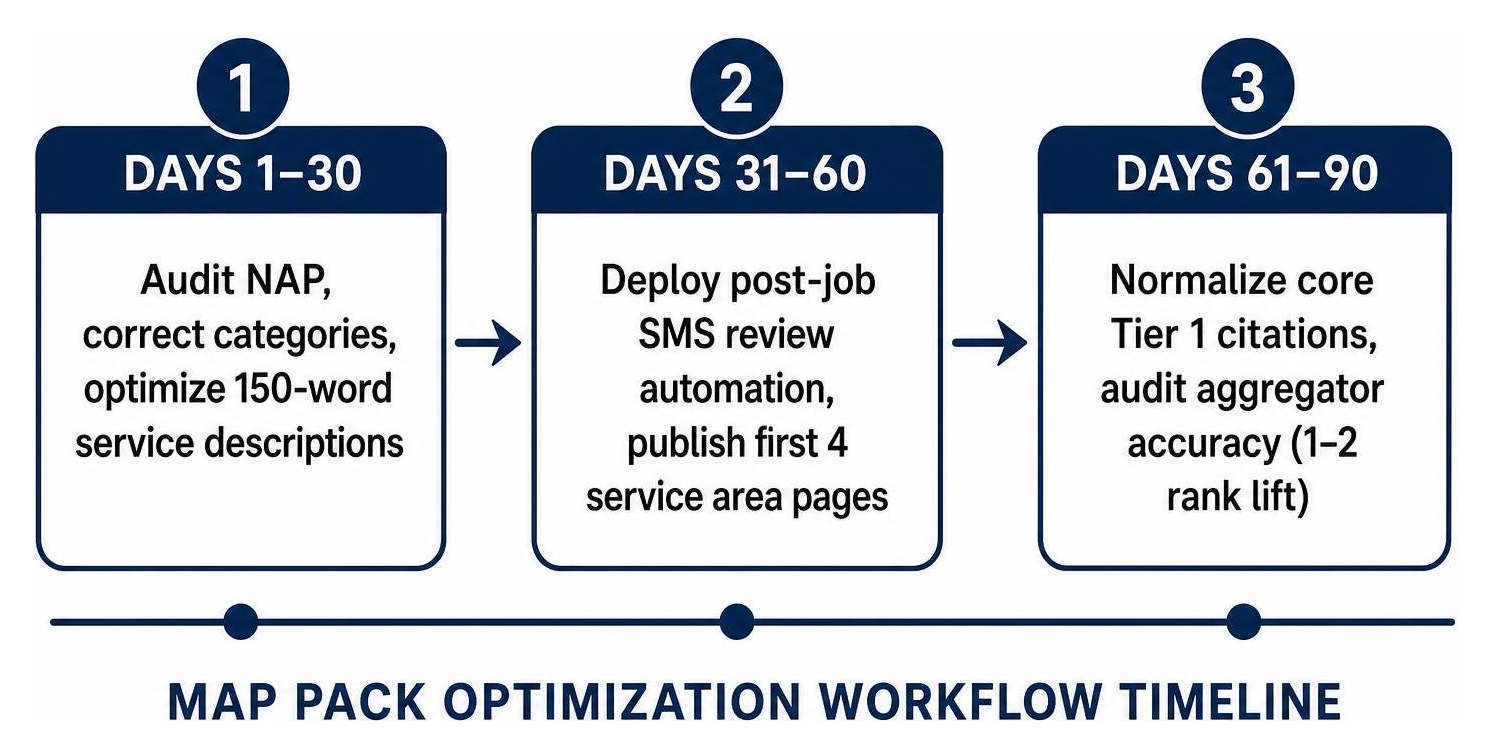
Month 1 to 3: Relevance Fixes and Citation Baseline
The initial 90 days focus on correcting structural profile weaknesses and eliminating citation inconsistencies:
- Category Standardization: Verify that "Roofing Contractor" is your primary category and add relevant secondary classifications.
- NAP Audit & Cleansing: Identify and correct conflicting address formats, legacy tracking phone numbers, and outdated business names across Tier 1 networks.
- Service Description Overhaul: Write and publish complete descriptions for every commercial and residential service offered.
- Review Automation Rollout: Connect SMS review prompts directly to your CRM workflow to capture customer feedback immediately after final job walk-throughs.
- Initial Service Area Architecture: Publish the first two to four localized city landing pages on your website.
Completing these baseline relevance and data adjustments typically yields a 1 to 2 position lift in local pack visibility within 60 to 90 days.
Month 4 to 6+: Prominence Compounding and Lead Generation
Moving from position 4 into a stable top-3 placement requires sustained prominence compounding:
- Sustained Review Cadence: Maintain an automated intake of 5 to 8 authentic, location-specific reviews per month with active 24-hour owner responses.
- Paced Citation Distribution: Build 5 to 10 high-quality local and trade citations weekly across niche platforms.
- Service Area Expansion: Publish 1 to 2 new geo-targeted service area pages per week, linking them with localized GBP project posts.
- Localized Link Acquisition: Secure authentic backlinks from local building supply distributors, regional homebuilder associations, and community sponsorships.
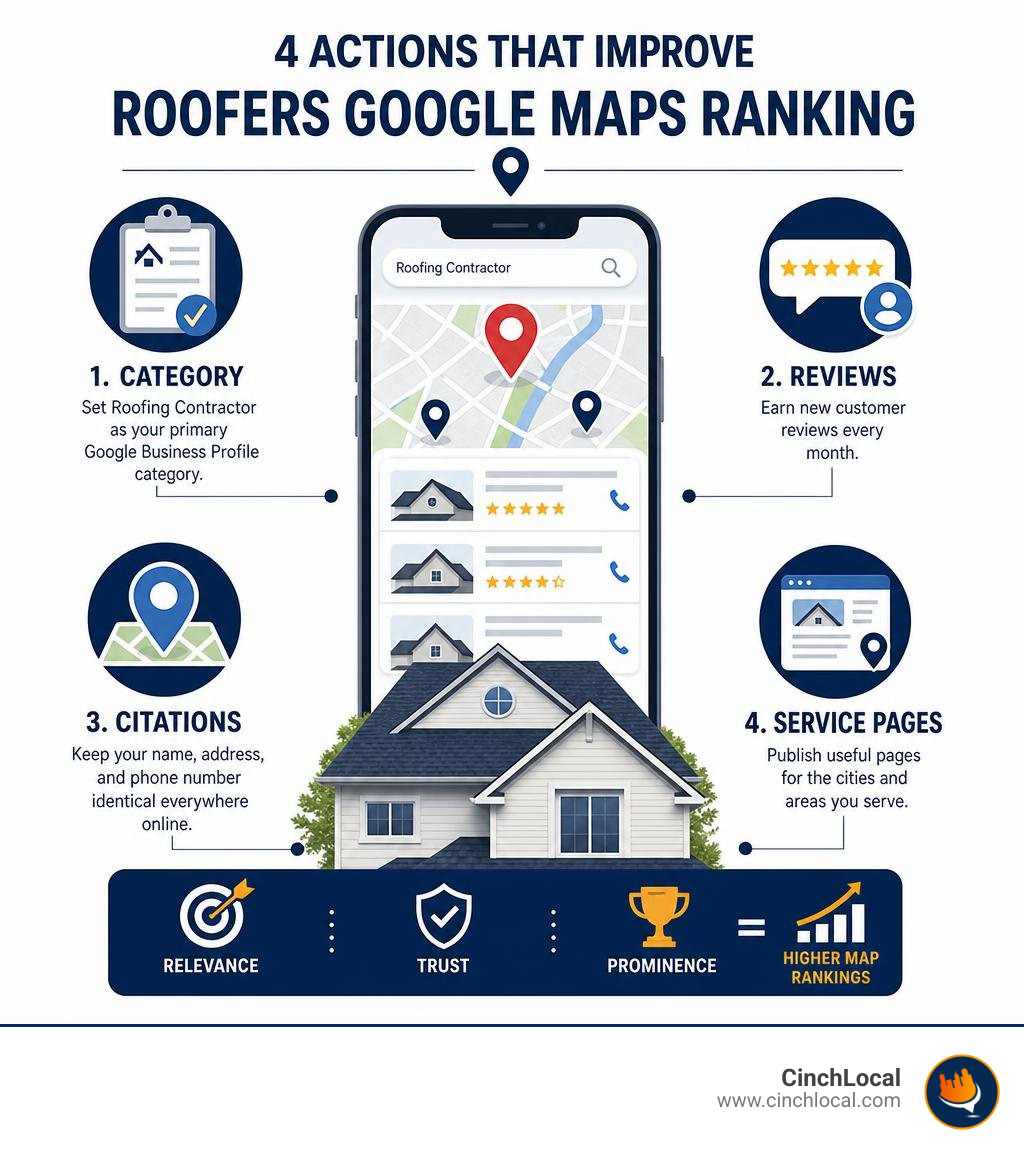
In medium-competition markets, this disciplined approach produces stable top-3 rankings within 6 to 9 months. Highly competitive major metropolitan areas across California, Texas, and Georgia may require 12 to 18 months of continuous optimization to reach position 1.
Frequently Asked Questions About Roofing Local SEO
How long does it take for a roofer to rank in the Google local 3-pack?
Correcting baseline relevance issues (primary categories, service menus, and core NAP inconsistencies) typically produces a 1 to 2 position ranking lift within 60 to 90 days. Achieving top-3 stability in medium-competition markets generally takes 6 to 9 months of consistent review generation and citation growth, while competitive metro areas can require 12 to 18 months of continuous prominence building.
Can roofing contractors use a virtual office address to rank in adjacent cities?
No. Using virtual offices, shared co-working dropboxes, or P.O. boxes violates Google Business Profile policies and routinely leads to listing suspension. To rank in adjacent cities where you lack a physical location, build high-quality, localized service area landing pages on your primary website that feature local project photos, client reviews, and schema markup.
Does a roofing company need high website rankings to appear in the map pack?
While a website does not have to hold position 1 organically for its associated GBP to appear in the map pack, website domain authority and localized on-page content directly influence map rankings. Your website serves as the primary verification source for Google's algorithm; listings supported by well-structured websites with comprehensive location pages consistently maintain higher and more stable local pack positions.
Dominate Your Local Market with Proven Roofing SEO
Securing top-3 map pack positions is a proven method for generating exclusive, high-margin commercial and residential roofing leads. Consistently generating reviews, maintaining accurate NAP citations, and structuring localized service pages establishes an authoritative digital presence that drives inbound calls.
At CinchLocal, we build tailored search marketing systems designed specifically for roofing contractors across the United States. Through our proprietary Roofer Footprint Expansion System, we deliver measurable Google Maps visibility and qualified leads within 30 days.
Ready to dominate the map pack in your local service territory and secure consistent inbound roofing jobs? Schedule your strategy consultation with our local search specialists today to start expanding your market footprint.
Want Us to Uncover Hidden 'Footprint Gaps' And Critical Blind Spots That’s Quietly Draining Calls, Jobs, and Profits?
Simply Fill Out The Form Below:
What If You Could Stop Wasting $30K+ a Year on Dead-End Marketing - And Finally Become the Go-To Roofer in Your City?
Other Helpful Articles You Might Enjoy