
How to Get More Targeted Facebook Ads Leads for Roofers in 5 Simple Steps

Cary Byrd // Founder of CinchLocal
Why Most Roofers Waste Money on Facebook — and What Actually Works
Targeted Facebook ads for roofers are one of the most cost-effective ways to generate exclusive roofing leads in 2026 — and this guide shows you exactly how to run them in 5 simple steps.
Here's a quick answer if you're short on time:
- Install the Meta Pixel and Conversions API on your website before spending a single dollar on ads
- Target homeowners aged 35–65 in your service area using interest-based and demographic filters
- Use before-and-after photos and short video testimonials as your primary ad creative
- Build a multi-layer funnel — cold prospecting, retargeting, and storm response campaigns
- Follow up with every new lead within 5 minutes using automated SMS or CRM notifications
Here's a scenario that's painfully common: a roofing company spends $2,000 a month on Facebook ads. The dashboard shows solid reach and decent engagement. But the phone barely rings.
Meanwhile, a competitor down the street is booked out for six weeks.
The difference usually isn't budget. It isn't even the market. It's strategy.
The hard truth is that 71% of U.S. adults use Facebook, and 58% of adults aged 30–49 log in daily. Your future customers are scrolling right now. The question is whether your ads are stopping them — or getting ignored.
Traditional lead sources like shared lead generation networks often deliver shared, low-quality leads that go cold fast. One roofing contractor in a Facebook discussion group described spending $4,000 a month on leads and completing only 6–10 roofs — numbers that don't leave much margin. Targeted Facebook ads, when built correctly, replace that guesswork with a system you own and control.
A local lead generation agency that specializes in roofing can help you build exactly that kind of system — one where every dollar of ad spend has a clear path to a signed contract.
I'm Cary Byrd , CEO of CinchLocal, a roofing marketing agency based in Boerne, TX, where I've spent years helping roofing contractors generate targeted Facebook ads leads through precision audience targeting, high-converting creative, and full-funnel campaign architecture. If you're ready to stop guessing and start scaling, this guide is built for you.
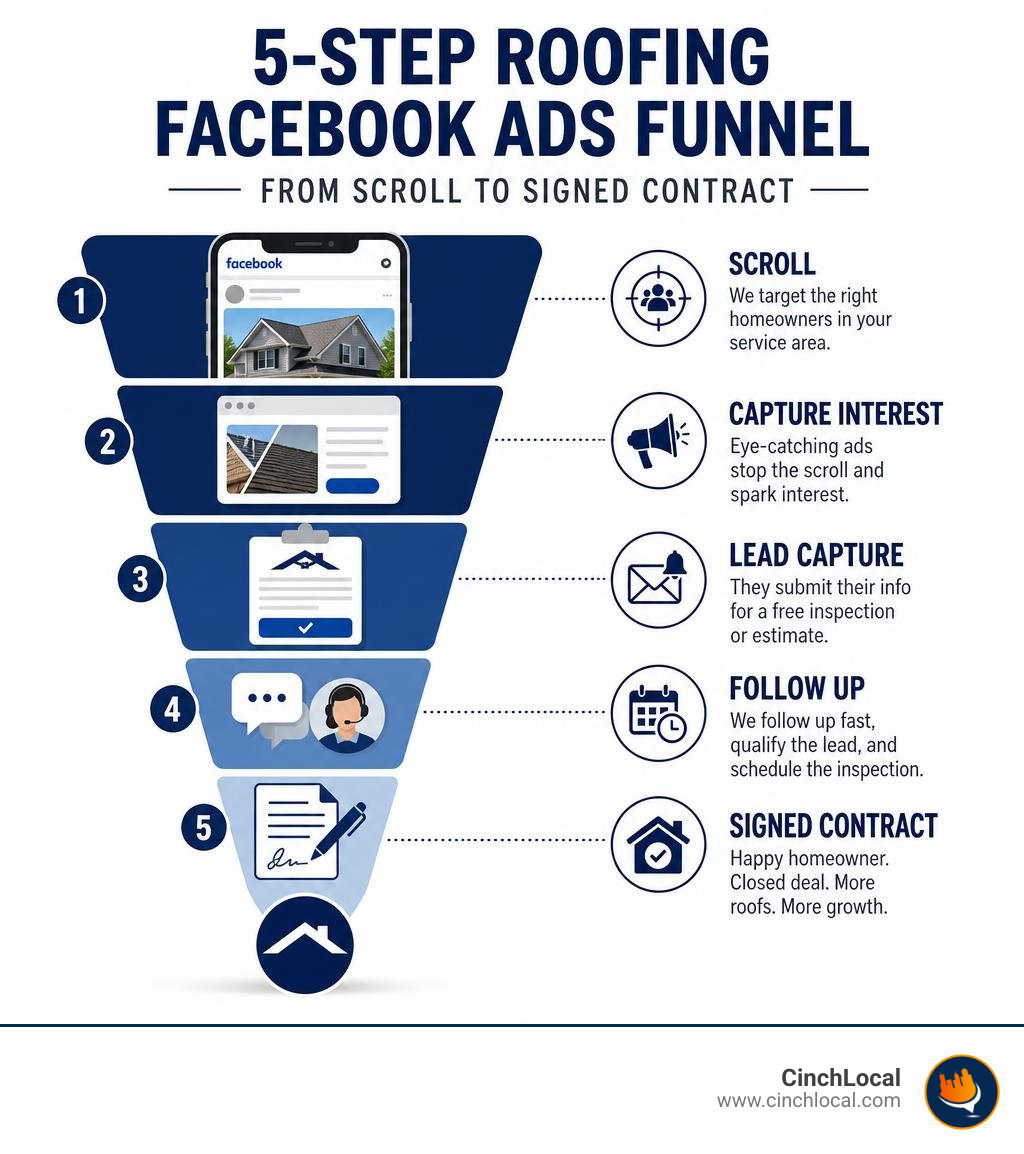
Why Targeted Facebook Ads Roofers Outperform Traditional Outbound Marketing in 2026
For decades, roofing contractors relied on "shotgun" outbound marketing: direct mailers, local flyers, yard signs, and expensive highway billboards. While these methods can build local awareness, they suffer from a massive flaw: they are completely untargeted and passive. You are paying to show your message to thousands of people who rent, recently replaced their roofs, or simply don't care.
In 2026, targeted Facebook ads roofers deploy allow us to shift from passive outbound marketing to proactive demand generation. Instead of waiting for a homeowner to notice a flyer, we place highly visual, localized, and contextually relevant offers directly in front of qualified property owners at the exact moment their roofs are most vulnerable.
Cost Per Lead (CPL) Benchmarks
The financial advantage of Meta's platform over traditional outbound channels and even high-intent search channels like Google Ads is clear. Industry-wide WordStream Facebook Ads benchmarks show that lead-objective campaigns in the home and home improvement category average a $41.26 Cost Per Lead (CPL) , with a 5.22% conversion rate and a $2.23 Cost Per Click (CPC) .
Compare this to Google Search campaigns, where the average CPL for roofing and gutters often hovers around $228.15 . While Google Search captures active, immediate intent, Facebook allows you to generate massive lead volume at a fraction of the cost, planting the seed of trust before homeowners even begin searching.
| Metric / Feature | Targeted Facebook Ads (2026) | Traditional Outbound (Mailers/Billboards) | Google Search Ads (Roofing) |
|---|---|---|---|
| Average Cost Per Lead (CPL) | $35.00 - $75.00 | $150.00 - $300.00+ | $200.00 - $250.00+ |
| Audience Targeting Precision | Ultra-precise (demographics, zip codes, behaviors) | Extremely broad (geographic only) | High (keyword intent only) |
| Visual Capability | High (video walkthroughs, before/after carousels) | Low (static print images) | None (text-only search ads) |
| Scalability | Instantaneous (raise daily budget with click of a button) | Slow (printing, sorting, mailing lead times) | Limited by local search volume |
To maximize your return on ad spend (ROAS), you must ensure that your backend sales pipeline is secure. Many contractors generate cheap leads but lose them to slow follow-up or confusing booking processes. If you want to stop burning cash, take a look at our detailed guide on how to stop your roofing leads from leaking on Facebook.
Steps 1 & 2: Technical Setup and Audience Targeting Strategies
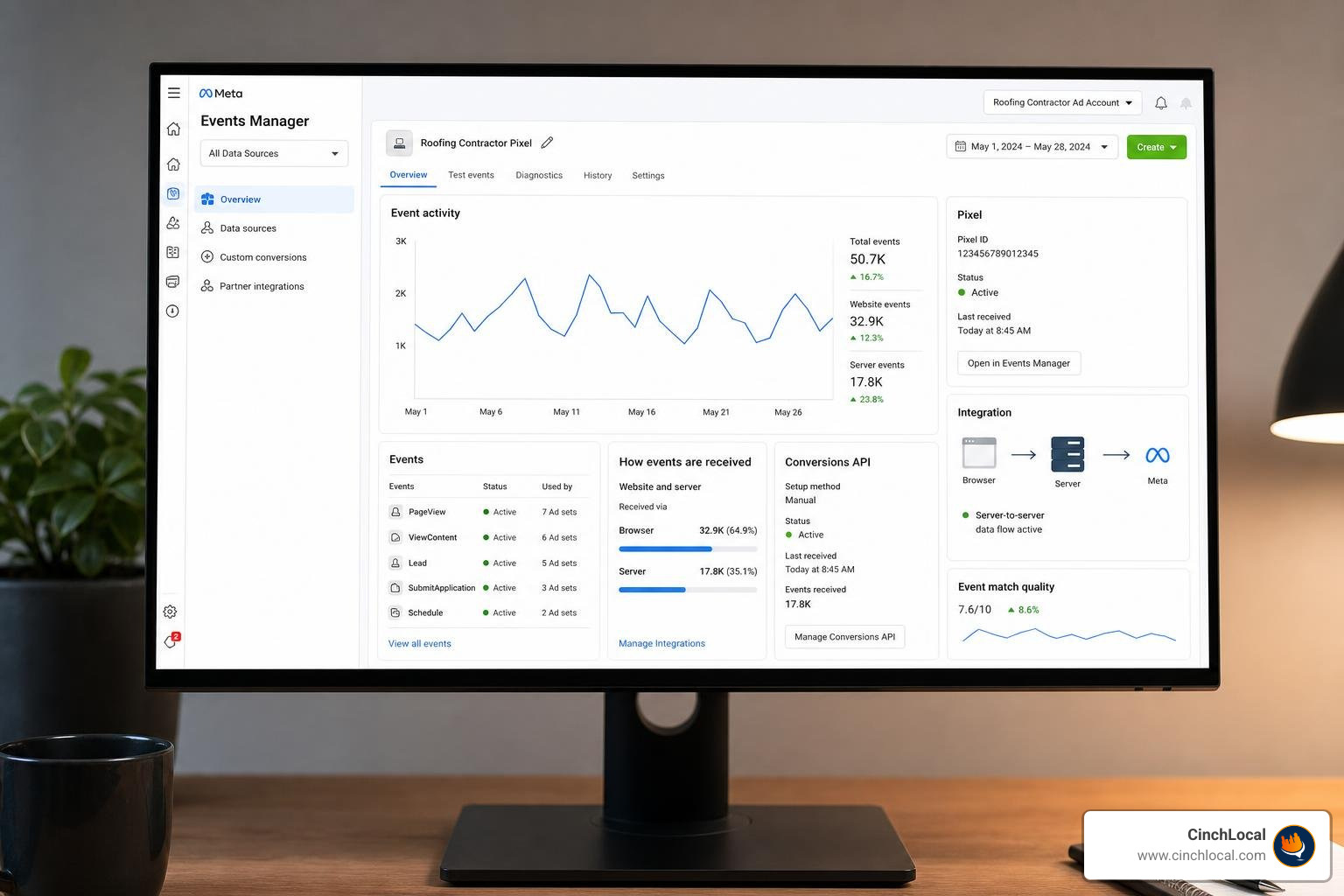
The Technical Foundation: Pixel, CAPI, and Google Tag Manager
If you want your campaigns to succeed, you cannot rely on basic targeting or boosted posts. Successful campaigns are built on clean, reliable data.
To track conversions accurately in 2026, you must implement the Meta Pixel alongside the Conversions API (CAPI) . With the phasing out of third-party browser cookies and the rise of strict ad blockers, relying solely on browser-side tracking (the Pixel) will result in lost conversion data. CAPI establishes a direct server-to-server connection between your website and Meta, ensuring that every lead, booked inspection, and closed contract is attributed to the correct ad.
We highly recommend using Google Tag Manager (GTM) to manage your setup. GTM allows you to implement event deduplication . Because both the Pixel and CAPI track user actions, GTM ensures Meta doesn't count a single lead submission twice, keeping your cost-per-acquisition data clean. To ensure your server-side tracking complies with current data privacy standards, consult the official Meta Business Help Center on Conversions API.
For a complete, click-by-click walkthrough of how to set up your tracking, budget, and ads properly, explore our step-by-step guide on how to optimize Meta ads for roofers in 7 easy steps.
Geographic Precision and Meta's Advantage+ Algorithms
A common mistake roofers make is targeting an entire major metropolitan area. This dilutes your budget and forces your crews to travel hours between jobs.
Instead, target specific, high-value zip codes or drop a pin over target neighborhoods with a tight 3 to 5-mile radius . Focus your budget on areas with older housing stock or neighborhoods where you already have active jobs.
Once your geography is locked in, leverage Meta’s Advantage+ audience algorithms . Instead of micro-managing every targeting detail, let Meta's AI analyze your historical customer data (captured via CAPI) to find similar homeowners in your target radius.
Leveraging Local Demographics with Targeted Facebook Ads Roofers
While Meta’s AI is powerful, layering basic demographic guardrails ensures you aren't showing high-ticket roof replacement ads to college students renting apartments.
- Age and Financial Authority: Target users aged 35 to 65+ . This demographic represents the vast majority of homeowners who have the financial stability and decision-making authority to approve a $10,000 to $25,000 roof replacement.
- Property Insights: Use official housing data from the US Census Bureau Housing Portal to identify neighborhoods with homes built 15 to 25 years ago. This is the "sweet spot" where asphalt shingle roofs naturally reach the end of their lifespans.
- Interest-Based Overlays:
Layer your geographic targeting with interests that strongly correlate with homeownership. Good examples include:
- Home improvement
- Do It Yourself (DIY)
- Home insurance
- Lawn care and gardening
By combining these filters, you create a highly receptive audience. If you are brand new to setting up audiences inside Meta Ads Manager, start with our foundational guide on roofing Facebook ads 101.
Retargeting and Custom Audiences for Targeted Facebook Ads Roofers
The real money on Facebook is made in the retargeting layer. Most homeowners do not buy a new roof on their first interaction with your brand. They need multiple touchpoints to build trust.
We structure our retargeting strategy using three primary custom audience buckets:
- Customer Database Uploads: Export your CRM list of past customers, old leads who never closed, and lost opportunities. Upload this list securely to Meta to create a Custom Audience. You can run reactivation campaigns offering roof tune-ups or gutter cleanings to past clients, or hit old leads with financing promotions.
- Lookalike Audiences: Once you upload a list of at least 100 to 500 of your best past customers, instruct Meta to build a 1% to 2% Lookalike Audience . This tells the algorithm: "Find more homeowners in my state who behave exactly like the people who have already paid me."
- Website and Video Engagement Retargeting: Use URL-based retargeting to capture users who visited your "Free Estimate" page but left before filling out the form. Show them social proof, trust badges, and reviews to overcome their hesitation.
To understand how to weave these custom audiences into a cohesive digital strategy, check out our deep-dive resource on roofing Facebook ads.
Steps 3 & 4: High-Converting Ad Creatives and Multi-Layered Funnels
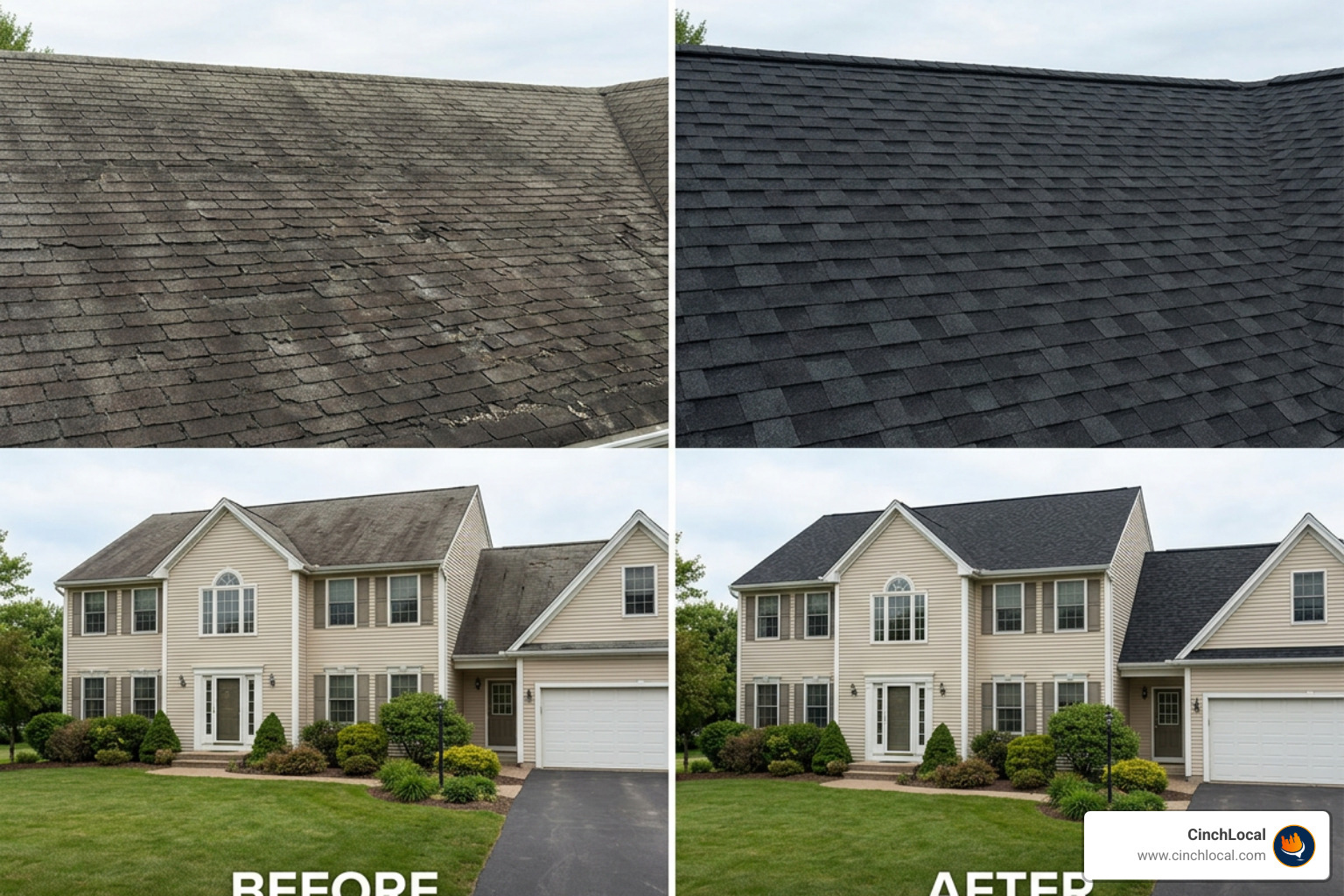
Visual Assets That Convert: Real Work Over Stock Photos
If your ad features a generic stock photo of a smiling contractor or a close-up of a bundle of shingles, your campaign is going to struggle. Homeowners scroll right past corporate-looking advertisements.
Your creative needs to look like organic content posted by a neighbor. The highest-converting visual assets for roofing are:
- Before-and-After Carousels: Show a dirty, wind-damaged roof on card one, and a clean, beautiful new architectural shingle roof on card one's right.
- Smartphone Video Walkthroughs: Have your project manager or company founder record a quick, selfie-style video on a job site. "Hey local homeowners, we're out here in Stone Oak replacing this 20-year-old roof. Let me show you what storm damage actually looks like..."
- Time-Lapse Project Videos: Compress a two-day roof replacement into a 30-second time-lapse. It's satisfying to watch and keeps eyes glued to your ad.
The Problem-Solution-Offer Copy Structure
To turn views into leads, your ad copy must follow a structured, persuasive framework:
- The Hook (Problem): Address a specific pain point immediately. "Think your roof survived last night's hail?" or "Is your roof over 15 years old?"
- The Explanation (Solution): Introduce your company as the local, trusted expert. "At Apex Roofing, we've helped over 500 local homeowners secure storm damage replacements with zero out-of-pocket hassle."
- The Low-Friction Call to Action (Offer): Make it incredibly easy to take the next step. "Don't wait for a leak to ruin your ceiling. Click below to claim your Free 21-Point Digital Roof Inspection today. Only 15 slots available this week!"
Multi-Layered Funnel Architecture
To build a truly scalable system, we deploy a three-layer campaign structure:
- Prospecting Layer: Broad-reach campaigns focused on educating homeowners about roof age, common leak areas, and local projects.
- Retargeting Layer: Direct-response ads served to website visitors and page engagers, showing Google reviews, warranties, and flexible financing options (e.g., "New roof for as low as $99/month" ).
- Storm Response Activation: Pre-built, paused campaigns ready to launch within 4 hours of a major weather event. These target the exact path of the storm with messaging focused on storm-damage inspections and insurance claim assistance.
For a library of proven ad templates and copy examples, read our guide on from shingles to singles: best Meta ads for roofers that convert.
To ensure your ad visuals and messaging comply with Meta's advertising policies while maintaining high engagement, review Meta's official guidelines on creative considerations for local businesses.
Step 5: Budgeting Benchmarks and Rapid Follow-Up Systems
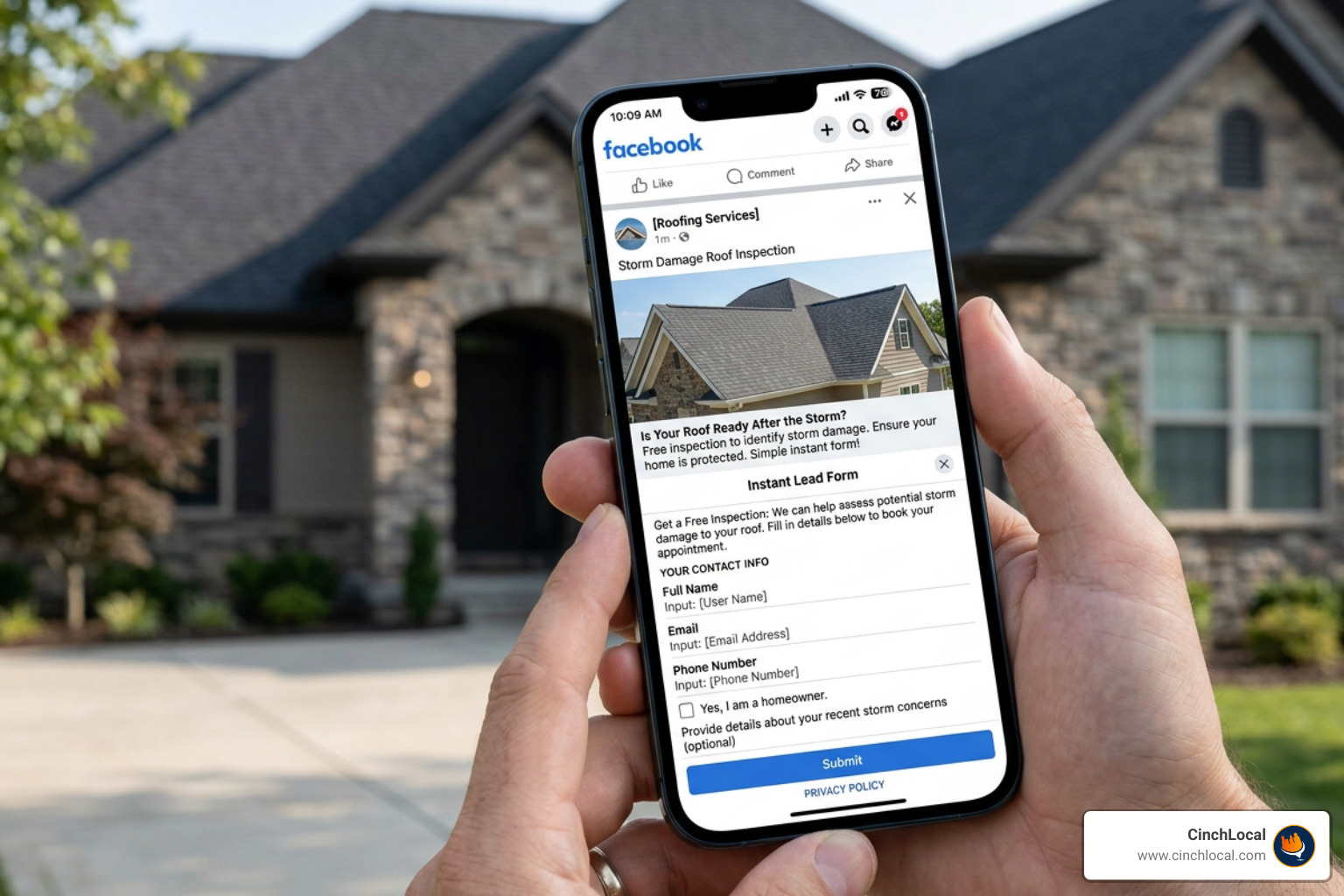
Setting Your Budget for Success
We recommend starting with a daily testing budget of $25 to $50 per ad set . This gives Meta's algorithm enough data to test different creatives and audiences without burning through your capital.
Once you identify a winning combination (an ad that delivers leads within your target CPL), you can scale your budget by 20% to 30% every 3 to 5 days . For established roofing companies looking to dominate their local market, a monthly budget of $1,500 to $3,000 is the sweet spot to keep 2 to 3 crews consistently busy.
The Speed-to-Lead Rule: Why Minutes Matter
You can have the most beautiful, targeted ads in the world, but if your follow-up is slow, your campaign will fail.
A landmark study published by the Harvard Business Review on online sales leads revealed that businesses that attempt to contact online leads within 5 minutes are nearly 7 times more likely to have a meaningful conversation with a decision-maker than those that wait even an hour.
In roofing, homeowners often submit forms to multiple companies. The contractor who calls first is almost always the one who wins the inspection and closes the job.
Automated Lead Qualification Systems
To maintain a 5-minute response time, you must automate your backend. Connect your Meta Lead Forms directly to your CRM (like JobNimbus or ServiceTitan) using integration tools.
Set up an automated sequence that triggers the second a lead is submitted:
- Instant SMS: "Hi John, this is Cary with Apex Roofing. I saw you requested a free roof inspection for your property on Oak Street. Do you have 2 minutes for a quick call to schedule our inspector?"
- Instant Email: Send a confirmation email containing a link to your calendar (using booking tools like Calendly) so they can schedule their inspection immediately.
Instant Forms vs. Custom Landing Pages
- Meta Instant Forms (Lead Ads): These keep the user inside the Facebook app, auto-filling their name, email, and phone number. This format reduces friction, resulting in a 25% to 35% higher completion rate and a lower CPL.
- Custom Landing Pages: If you struggle with lead quality (e.g., people claiming they "filled out the form by mistake"), direct traffic to a dedicated landing page on your website. Use a multi-step questionnaire to pre-qualify them by asking about roof age, insurance status, and whether they own the home.
To learn more about converting raw lead volume into actual booked appointments, explore our complete guide on roofing leads.
For real-world discussions and peer insights on how other contractors handle lead follow-up and CRM integrations, check out this active thread in the Facebook Group for roofing lead generation.
Frequently Asked Questions About Roofing Facebook Ads
How much do targeted Facebook ads for roofers cost in 2026?
On average, roofing contractors see a Cost Per Lead (CPL) of $35 to $75 in suburban and rural markets. In highly competitive urban areas or immediately following a major storm event, CPL can range from $75 to $120 . Cost Per Click (CPC) typically averages between $1.50 and $3.50 , making it highly cost-effective compared to search engine alternatives.
Should roofers use Facebook Lead Ads or landing pages?
We recommend starting with Facebook Lead Ads (Instant Forms) using "Higher Intent" settings. This balance provides a low CPL while filtering out accidental submissions. If your sales team is small and you only want highly qualified leads, shift to custom landing pages with detailed qualification forms.
How quickly do Facebook ads start generating roofing leads?
You will typically see your first leads within 24 to 72 hours of launching your campaign. However, Meta's algorithm requires roughly 50 conversions per ad set to exit its "learning phase." Plan for a 30 to 90-day testing period to fully optimize your targeting, creatives, and budget for maximum ROI.
Conclusion: Dominate Your Local Market with Smarter Digital Marketing
Relying solely on word-of-mouth, yard signs, or shared leads from third-party aggregators is a recipe for unpredictable revenue. To scale your roofing business in 2026, you need a predictable, automated pipeline of exclusive leads that you own.
By implementing the 5-step targeted Facebook ads system outlined in this guide, you can position your contracting business as the go-to local authority, keeping your crews busy year-round.
At CinchLocal , we specialize exclusively in the roofing industry, helping contractors in Ohio, Tennessee, Georgia, California, and across the USA build custom marketing engines. Our proprietary Roofer Footprint Expansion System combines targeted social media campaigns with local search dominance to guarantee pre-sold leads in your market.
Ready to take control of your lead flow and see real-world proof of our work? View our proven roofing marketing results to see how we help local contractors scale their businesses.
To capture homeowners who are actively searching for a roofer right now alongside those scrolling social media, combine your Facebook strategy with our specialized Google Maps local SEO for roofers service. Let's build a dominant digital presence for your business together.
Want Us to Uncover Hidden 'Footprint Gaps' And Critical Blind Spots That’s Quietly Draining Calls, Jobs, and Profits?
Simply Fill Out The Form Below:
What If You Could Stop Wasting $30K+ a Year on Dead-End Marketing - And Finally Become the Go-To Roofer in Your City?
Other Helpful Articles You Might Enjoy