


Cary Byrd // Founder of CinchLocal
Why Roofer Website SEO Optimization Is Your Most Valuable Business Asset

Roofer website SEO optimization is the process of making your roofing company's website show up when homeowners search Google for services you offer — turning your site from a digital business card into a 24/7 lead-generation machine.
Here's what effective roofing website SEO covers:
- On-Page SEO - Optimizing service pages, title tags, headings, and localized content
- Technical SEO - Site speed, mobile responsiveness, HTTPS security, and schema markup
- Local SEO - Google Business Profile, Google Maps rankings, and NAP citations
- Off-Page SEO - Backlinks, local citations, and online reviews
Right now, in July 2026, 78% of homeowners search for roofers online before making a single phone call. Word-of-mouth alone cannot scale a roofing business in that environment. Relying on referrals means your revenue depends on factors outside your control. Professional roofing marketing services build the kind of compounding online presence that keeps your phone ringing — regardless of whether your last customer referred you or not.
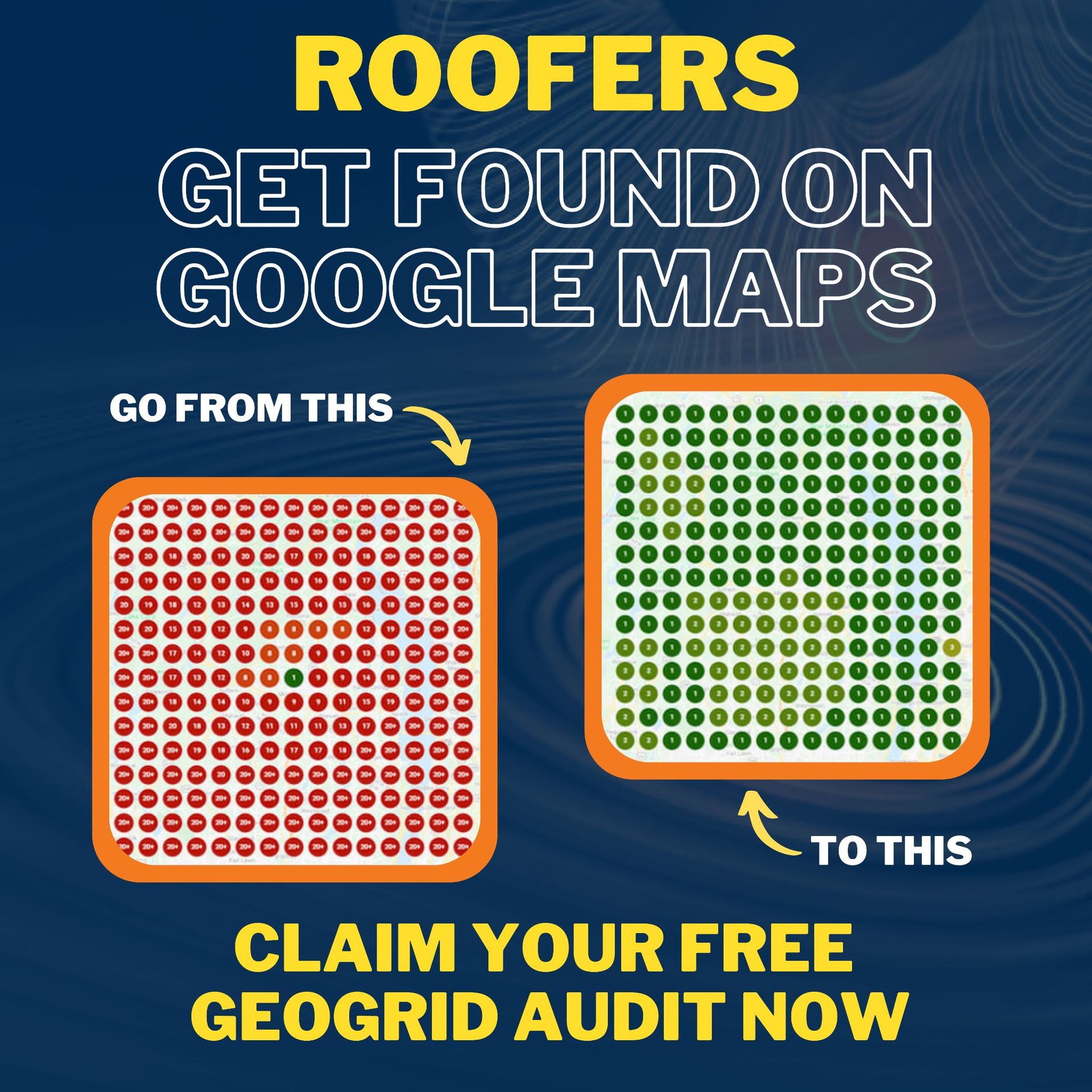
The core idea behind roofing SEO is active search intent . A homeowner Googling "roof replacement near me" right now is not browsing casually. They have a problem and they need someone today. Unlike a billboard or a radio ad that interrupts people who aren't thinking about roofing, SEO puts you directly in front of people who are already looking to hire. That difference is why acquiring customers through SEO costs 87% less than paid search.
That's the real power of organic traffic: it compounds. A page you optimize today keeps ranking — and keeps generating pre-sold leads — months and years from now, without paying per click.
I'm Cary Byrd, CEO and founder of CinchLocal, a roofing marketing agency based in Boerne, TX, and I've spent years helping roofing contractors across the country crack the code on roofer website SEO optimization to drive more calls, better Google Maps rankings, and a steady pipeline of exclusive leads. In this guide, I'll walk you through exactly what it takes to make your roofing website work as hard as you do.
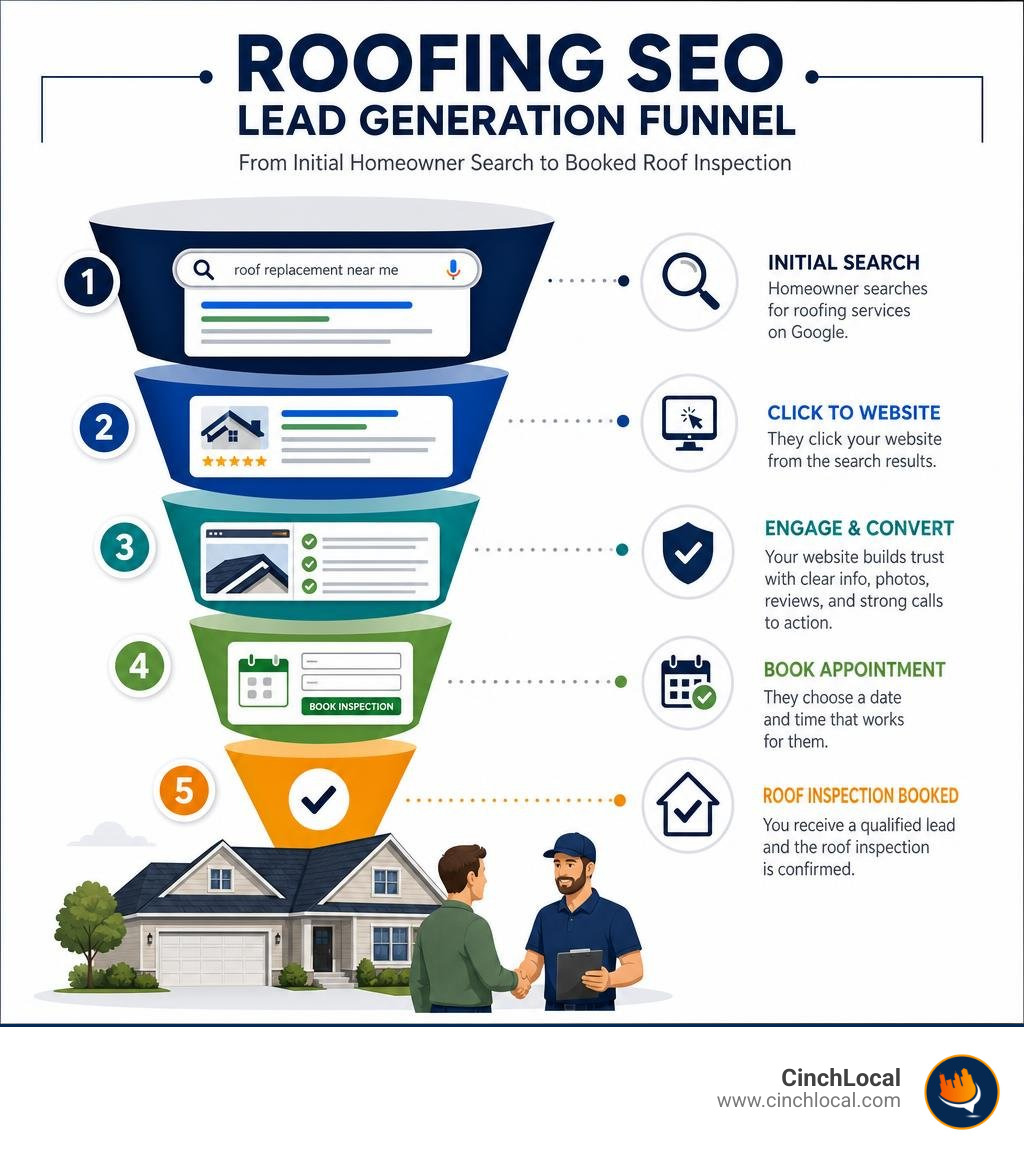
Roofer website SEO optimization terms to know:
What is Roofing SEO and Why Does It Matter for Contractors?
Roofing SEO is the intentional, strategic process of optimizing your roofing company’s online presence so that search engines rank your website at the top of organic search results for high-intent queries. It is not about tricking search engines; it is about providing clear, structured signals that match what search algorithms look for when determining who to trust in a local market.
When homeowners experience a sudden roof leak or realize their asphalt shingles are reaching the end of their lifespan, they do not wait for a flyer in the mail. They pull out their smartphones and search.
Active search intent leads to significantly higher conversion and close rates than any form of passive advertising. When you buy shared leads from third-party platforms, you compete with five other local contractors in a race to the bottom on price. When a homeowner finds you organically on Google, they are looking specifically at your brand, your reviews, and your expertise. They are pre-sold before they even request an estimate.
By investing in organic optimization, you build a permanent digital asset. While pay-per-click (PPC) ads stop generating leads the second you turn off your ad spend, a fully optimized website continues to rank, bringing in high-value commercial and residential roofing leads month after month. This creates a sustainable foundation that dramatically lowers your overall Customer Acquisition Cost (CAC) over time. Understanding why every roofer needs a solid SEO strategy is the first step toward breaking free from the feast-or-famine cycle that plagues many home service businesses.
| Metric / Feature | Organic Search Engine Optimization (SEO) | Paid Search Advertising (PPC / Google Ads) |
|---|---|---|
| Lead Generation Speed | Slow build (typically 3 to 6 months to rank) | Instant (ads display as soon as campaign is active) |
| Long-Term Cost | Compounding value; costs decrease per lead over time | High ongoing cost; you pay for every single click |
| Lead Quality & Trust | Exceptionally high; organic listings carry natural authority | Good; but some users actively skip sponsored ads |
| Residual Value | Permanent digital asset that ranks 24/7 | Zero; leads stop the moment budget is paused |
| Click Distribution | Map Pack and top organic results capture ~70% of clicks | Paid positions capture roughly 10% to 15% of clicks |
Core Pillars of Roofer Website SEO Optimization
To achieve a dominant position on search engine results pages (SERPs), your website must be optimized across four distinct areas. If you only focus on one pillar while ignoring the others, your rankings will eventually slip.
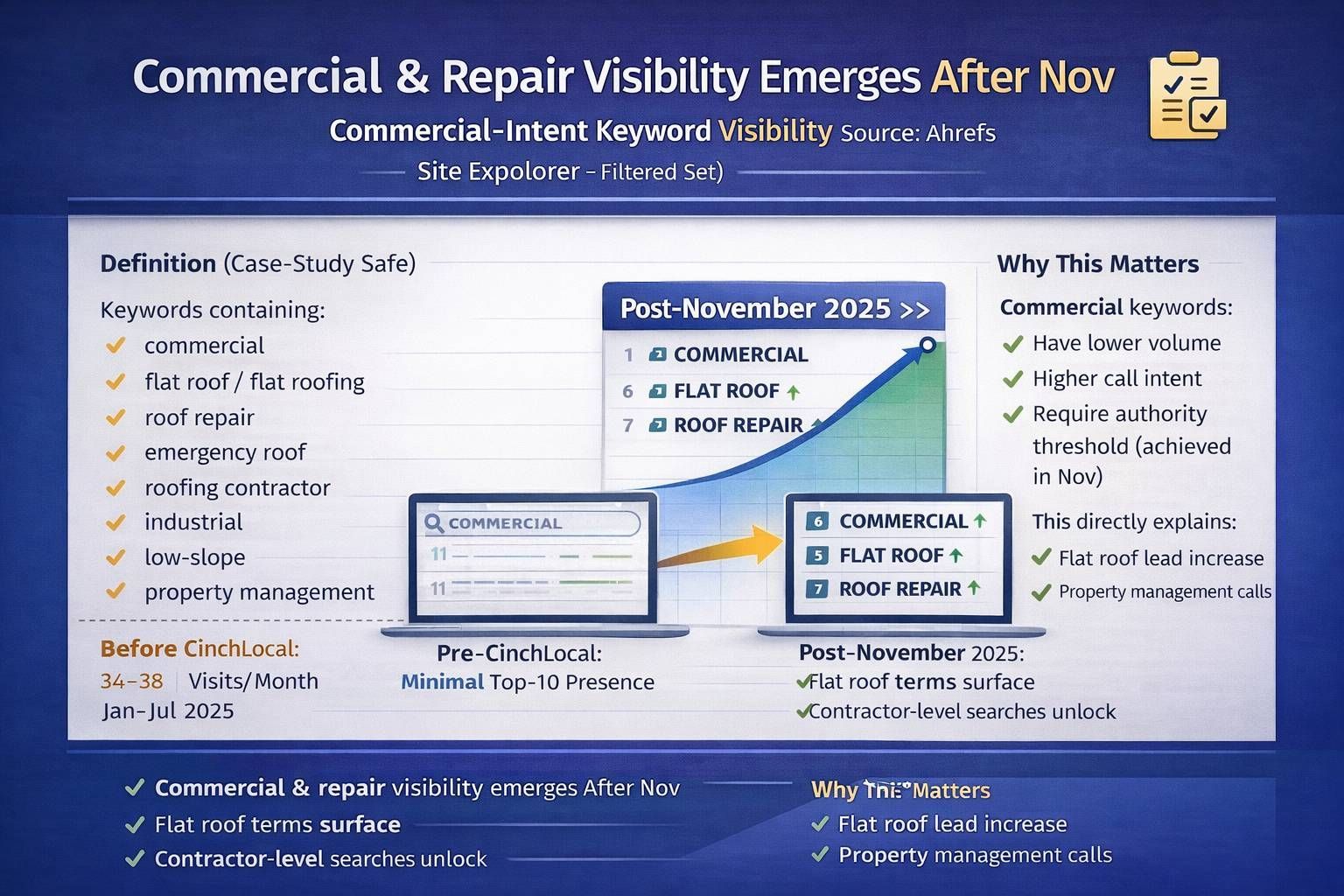
Our systematic approach to roofing marketing breaks down into these four essential pillars:
- On-Page SEO: This involves everything you can directly control on your individual web pages. It includes writing in-depth, helpful service descriptions, building dedicated city landing pages, structuring your headings correctly, and naturally integrating high-intent local keywords.
- Technical SEO: This is the underlying engine of your website. Search engines will not rank a site that is slow, insecure, or difficult to navigate. Technical SEO focuses on maximizing your site speed, implementing secure HTTPS protocols, ensuring perfect mobile responsiveness, and deploying structured schema markup.
- Local SEO: Since roofing is a hyper-local service, your visibility in your physical service area is paramount. This pillar focuses on optimizing your Google Business Profile (GBP), ranking in the Google Maps Local 3-Pack, and standardizing your business directories.
- Off-Page SEO: This is how you prove your authority and trustworthiness to search engines. It primarily involves earning high-quality backlinks from reputable local organizations, industry manufacturers, and home improvement publications.
To make sure your online assets are completely protected against search engine algorithm shifts, you must learn how to optimize your roofing site without falling off the SERP.
Want to know where your website currently stands? Contact us at CinchLocal today for a free, comprehensive website audit to identify immediate ranking opportunities in your local market.
On-Page SEO: Crafting High-Converting Service and Location Pages
Keyword Strategy for Roofer Website SEO Optimization
An effective keyword strategy for roofer website SEO optimization begins by separating informational keywords from high-intent commercial keywords.
Many contractors waste time trying to rank for highly competitive national terms like "how to repair a shingle." While these terms have high search volume, they attract DIYers from across the globe who will never buy a roof from you. Instead, you must target local, high-intent phrases that homeowners use when they are ready to write a check.
We prioritize explicit local keywords such as:
- "roof replacement Columbus OH"
- "emergency roof repair Nashville TN"
- "metal roofing contractors Atlanta GA"
- "Sacramento commercial roofing company"
These search terms combine your core service with your target geographic location. While they may have lower overall monthly search volumes than generic terms, their conversion rates are incredibly high. To successfully capture these ready-to-buy customers, you must implement a structured approach to roofing content and keyword optimization: raising the roof on your rankings.
On-Page Elements and Content Depth
Once you have identified your target keywords, they must be placed strategically within your page's HTML structure. Search engines read your code hierarchically to determine what your page is about.
- Title Tags:
This is the blue clickable link that appears on search results. It should always lead with your primary keyword and target city, kept under 60 characters. For example:
Roof Replacement San Jose CA | Apex Roofing. - Meta Descriptions: While not a direct ranking factor, a compelling meta description (under 160 characters) acts as your organic ad copy, directly influencing your click-through rate (CTR).
- Heading Hierarchy: Every page must have exactly one H1 tag at the top containing your primary target keyword. Use H2 and H3 tags to break up subtopics logically (e.g., "Our Asphalt Shingle Installation Process," "Frequently Asked Roof Replacement Questions").
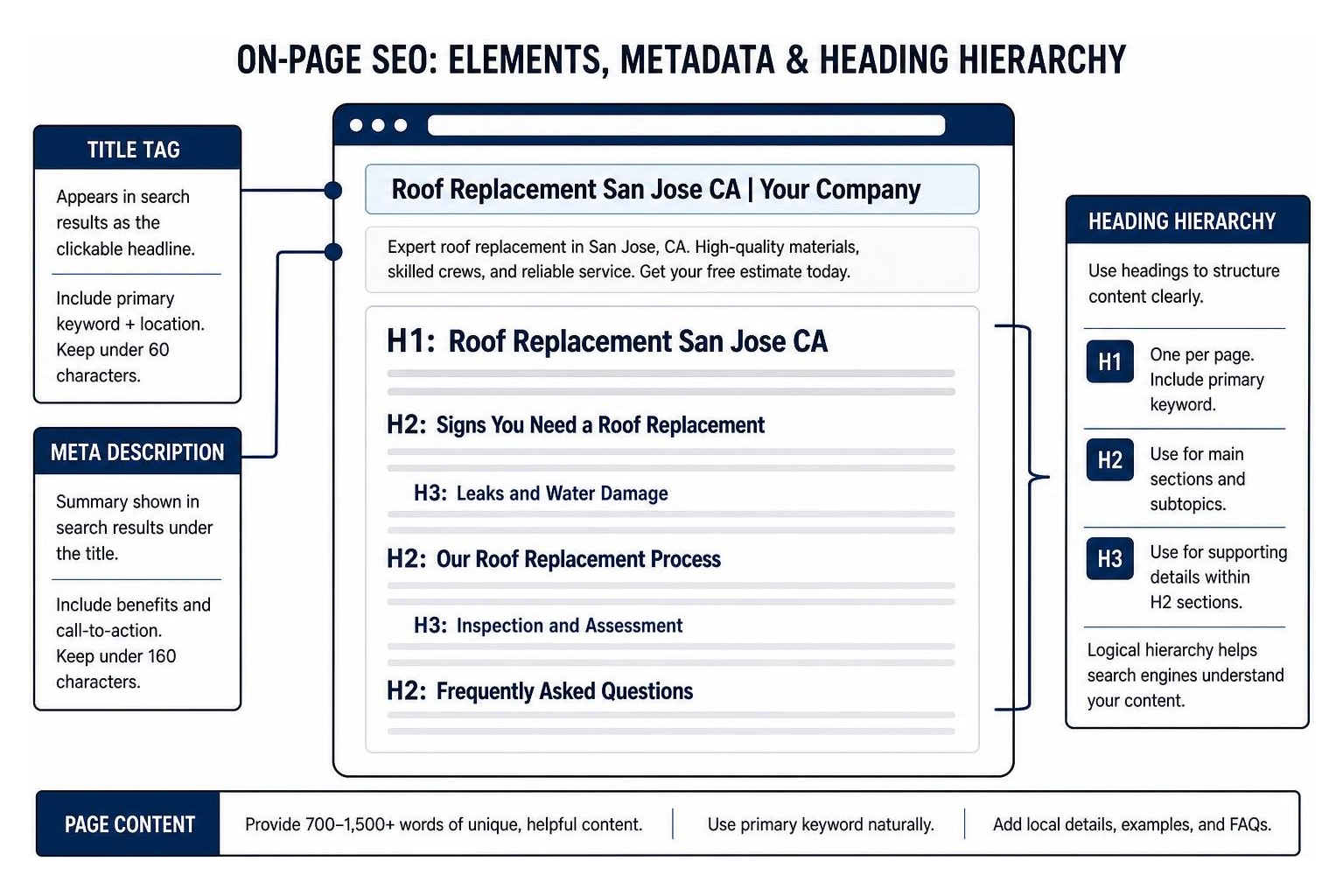
When it comes to the body copy of your service and location pages, thin content is a ranking killer. To establish topical authority, each core service page must contain a minimum of 700 to 1,500 words of unique, helpful content. Avoid copy-pasting the exact same text across multiple city pages and simply swapping the city name; Google’s algorithms easily detect this duplicate content and will downgrade your domain’s quality score.
Instead, write custom, localized content that details local building codes, regional weather challenges (like heavy snow in Ohio or intense heat in California), and actual local project examples. Learn more about crafting the perfect page: on-page SEO for roofers to maximize your page-level conversion rates. Furthermore, always align your content writing with Google's search essentials on creating helpful, reliable, people-first content to ensure long-term ranking stability.
Local SEO: Dominating Google Maps and the Local Pack
Google Business Profile Optimization
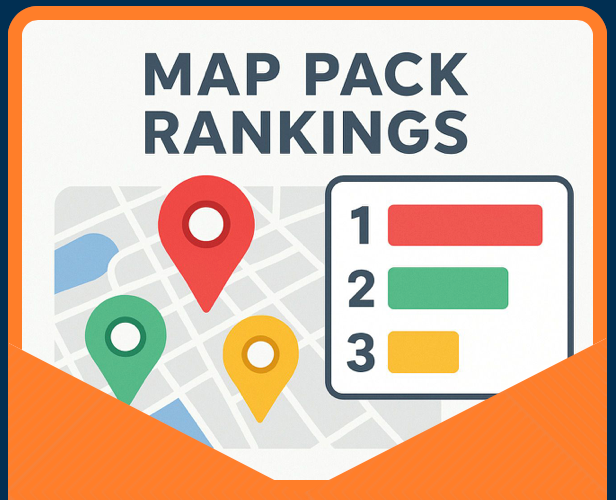
For roofing contractors, the Google Map Pack is the holy grail of local search. The top three local listings displayed alongside the map capture over 44% of all local search clicks.
To secure your spot in this highly lucrative real estate, you must completely optimize your Google Business Profile (GBP).
- Primary Category: Ensure your primary category is set exactly to "Roofing Contractor". Do not make the mistake of setting it to "General Contractor" if roofing is your primary driver of revenue.
- Service Areas: Clearly define your service areas by listing specific counties and major cities within your operating radius (e.g., in California, Georgia, Tennessee, or Ohio). Do not claim a physical address if you do not have a staffed office there; set your profile up as a Service Area Business (SAB) instead.
- Media Updates: Regularly upload high-resolution, geo-tagged photos of your crews on jobsites, completed roof installations, and your branded trucks. This signals to Google that your business is highly active.
We have refined this process into our proprietary "Roofer Footprint Expansion System," which systematically expands your local reach to outrank competitors who simply set up their profiles and ignored them. You can view our track record of helping contractors dominate their local maps on our proven local SEO results page.
Local Citations and Backlinks
A local citation is any online mention of your business’s Name, Address, and Phone number (NAP). Google cross-references these citations across hundreds of directories to verify that your business is legitimate and physically located where you say it is.
Any inconsistency in your NAP data—such as a different phone number on Yelp than on your website, or a slight spelling variation in your street address—creates algorithmic confusion. When Google’s bots get confused, they drop your rankings to protect their users from inaccurate data.
To prevent this, audit your listings across major platforms like Yelp, Angi, and local Chambers of Commerce to ensure absolute consistency. According to BrightLocal's local consumer review study, the prominence of positive reviews and consistent local citations directly impacts both local search algorithms and real consumer trust. Building a strong foundation of local citations is a non-negotiable step in executing a successful strategy for roofing SEO: how to dominate local search.
Technical SEO and AI Search Preparation
Technical SEO Non-Negotiables
Your website can have the most beautiful design and the best written content in the world, but if it fails Google's technical performance tests, it will remain buried on page two.
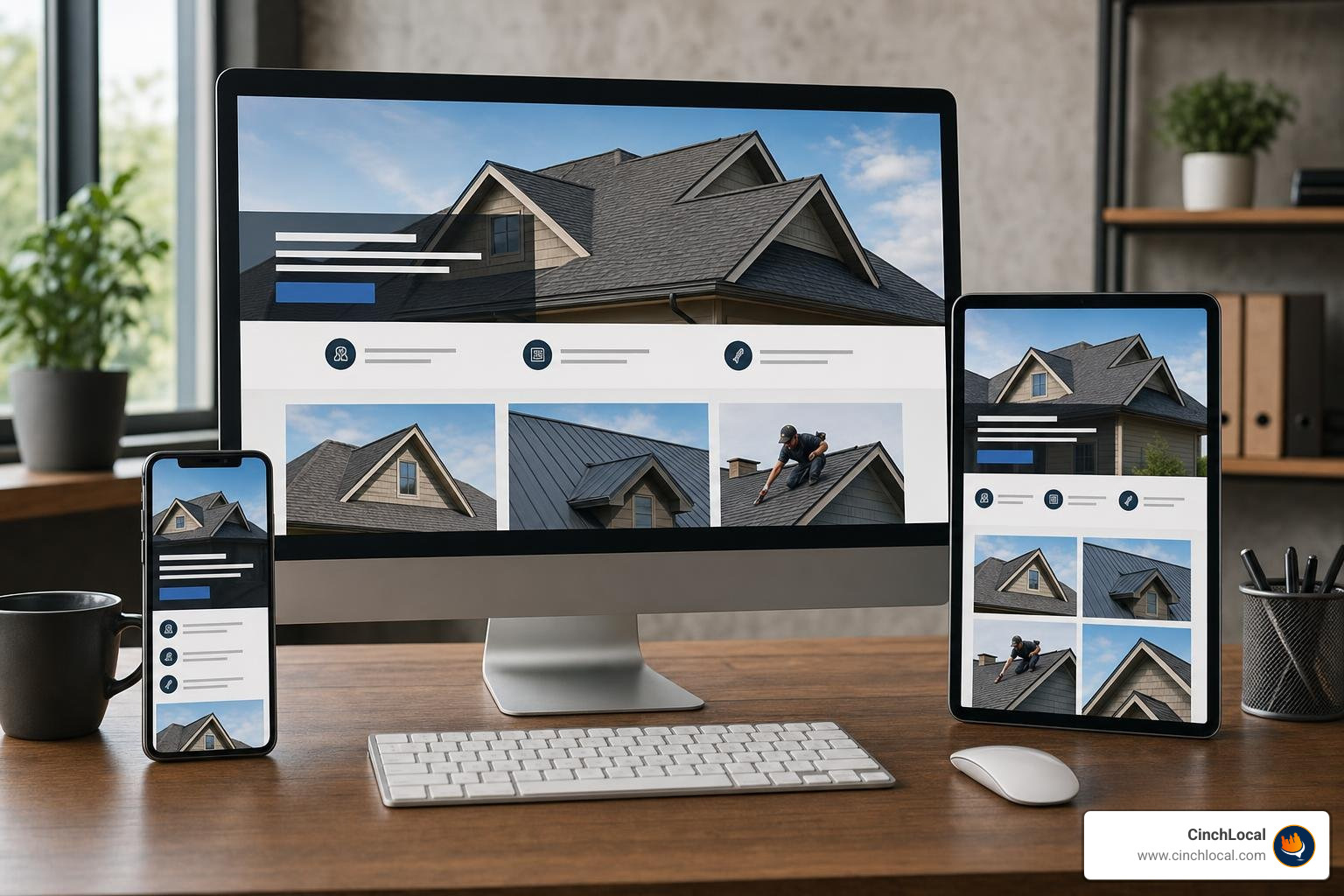
As of July 2024, Google operates exclusively on mobile-first indexing. This means the search engine evaluates and ranks your site based entirely on how it performs on mobile devices.
To pass Google's Core Web Vitals assessment, your site must load quickly, be easy to navigate on a touchscreen, and secure user data.
- Site Speed: Your Largest Contentful Paint (LCP)—the time it takes for the main content of your page to load—must be 2.5 seconds or less. Compress all project images into modern formats like WebP to prevent slow load times.
- SSL Security: Your site must run on HTTPS. An unencrypted HTTP site triggers a "Not Secure" warning in browsers, driving potential leads away immediately.
- Schema Markup: This is structured code added to your website that helps search engines understand exactly what services you offer, your service locations, and your customer reviews.
Make sure your site is built on a rock-solid technical foundation by reviewing our ultimate checklist for roofing contractor websites.
Optimizing for AI Search and Voice Queries
In July 2026, the search landscape is shifting rapidly. Homeowners are increasingly using AI-driven search engines like ChatGPT, Claude, Perplexity, and Google's AI Overviews to find local contractors. Additionally, voice search tools like Siri and Google Assistant are highly popular for hands-free local queries.
To optimize your roofing website for AI search engines, you must transition from simple keyword targeting to Semantic SEO . AI engines do not just look for exact keyword matches; they analyze the relationships between entities and concepts to provide conversational answers.
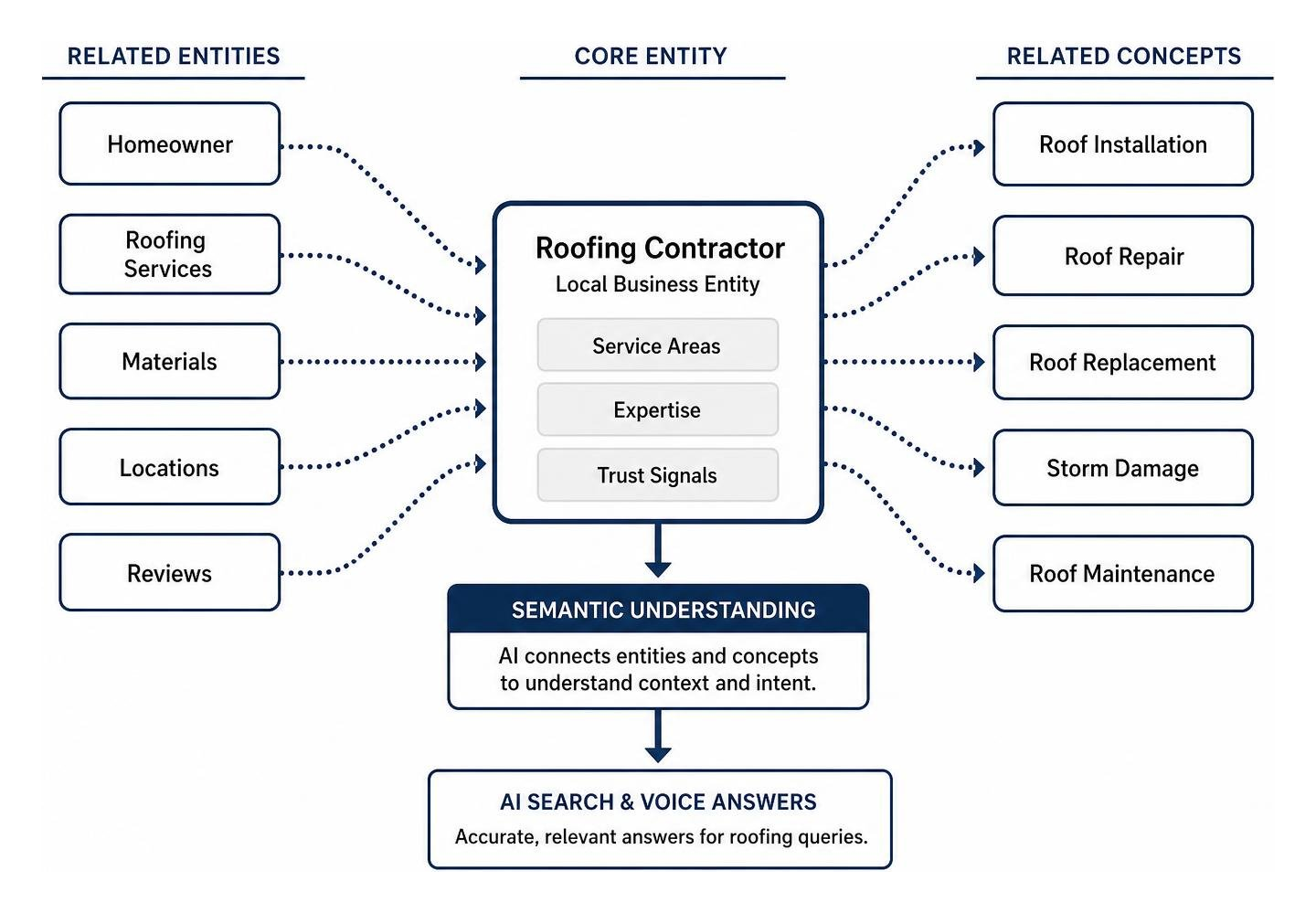
To be easily crawled and cited by AI engines, structure your content in a clear Q&A format. Create comprehensive FAQ sections on your service pages that address natural, conversational questions like "How much does a metal roof replacement cost in Ohio?" or "What are the signs of hail damage on an asphalt shingle roof?"
Most importantly, implement LocalBusiness and Service schema markup to explicitly define your business entity to search bots. You can learn how to deploy these structured code blocks by reading Google's official introduction to structured data.
Measuring Success and Avoiding Black-Hat Pitfalls
Key Metrics to Track
To ensure your digital marketing budget is delivering a strong return on investment, you must track the correct Key Performance Indicators (KPIs). Do not get distracted by vanity metrics like "impressions." You cannot pay your crews or buy materials with impressions.
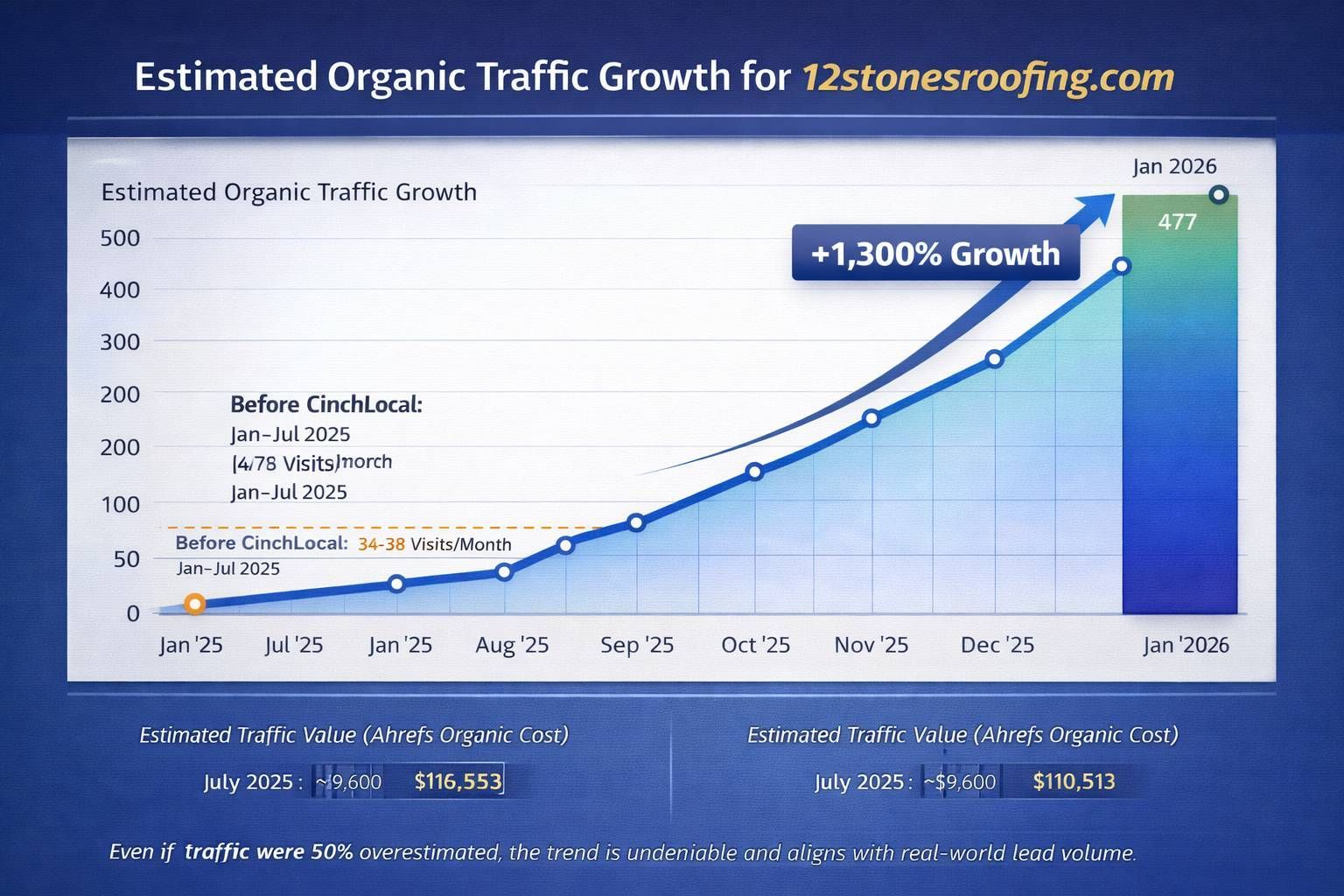
Focus on these core metrics to measure the true health of your campaign:
- Organic Traffic Growth: The number of unique visitors coming to your site via organic search results.
- Conversion Rate (Form Fills & Phone Calls): The percentage of website visitors who actually take action and contact you for an estimate.
- Google Maps Actions: The number of direct phone calls, website clicks, and driving direction requests generated straight from your Google Business Profile.
- Google Search Console Health: Monitoring for indexation issues, mobile usability errors, or search manual actions.
If you are wondering whether these digital efforts translate directly into actual bottom-line revenue, explore our detailed analysis of does SEO work for roofing business owners who want to scale their operations.
Black-Hat SEO Practices to Avoid
When choosing an agency to handle your search engine optimization, be highly wary of anyone promising instant page-one rankings. The roofing industry is heavily targeted by low-quality marketers who utilize risky "black-hat" techniques to manipulate rankings.
While these shortcuts may provide a temporary boost, they will eventually trigger a manual or algorithmic penalty from Google, completely erasing your website's online visibility overnight.
Critical black-hat practices to avoid:
- Keyword Stuffing: Artificially forcing your target keywords into your paragraphs over and over again until the text reads unnaturally.
- Duplicate City Pages: Creating hundreds of thin landing pages for every minor suburb using identical, templated copy with only the city name swapped out.
- Buying Backlinks: Purchasing cheap, low-quality links from link farms or private blog networks (PBNs) to artificially inflate your domain authority.
- Fake Reviews: Writing reviews for your own business or paying third parties to post fake customer feedback on your Google Business Profile.
Frequently Asked Questions About Roofer Website SEO Optimization
How long does roofer website SEO optimization take to show results?
For a brand-new website or a domain with no prior optimization history, it typically takes 3 to 6 months of consistent on-page, local, and technical optimization to see significant, sustainable ranking movement.
Search engines must first crawl, index, and gradually build trust in your website’s authority before ranking you above established local competitors. However, once this organic momentum is established, it creates a compounding lead-generation engine that continues to deliver high-quality, pre-sold leads for years to come.
Can I do my own roofing SEO or should I hire an agency?
While a motivated business owner can certainly handle basic on-page updates—such as writing blog posts or collecting Google reviews—managing a comprehensive, multi-location SEO campaign is highly complex and time-consuming.
Between keeping up with continuous Google core algorithm updates, managing technical schema markup, conducting competitor link-building outreach, and monitoring site performance, SEO is a full-time job.
Partnering with a specialized agency like CinchLocal allows you to focus on what you do best: running your crews and closing jobs. Our proprietary "Roofer Footprint Expansion System" is designed specifically to eliminate the guesswork, guaranteeing increased Google Maps visibility and pre-sold leads within your first 30 days.
How do reviews affect my local roofing rankings?
Online reviews are one of the most powerful ranking signals for Google Maps and the Local Pack. Google’s primary goal is to recommend the most reliable, trustworthy local businesses to its users.
A high volume of positive, fresh reviews signals to search algorithms that your business is active and highly regarded by local homeowners.
Furthermore, when your customers naturally include keyword-rich phrases in their reviews—such as "best shingle roof replacement in Nashville" or "highly professional roof repair crew"—it directly boosts your relevance score for those specific search terms.
Conclusion
In July 2026, a fully optimized roofing website is no longer an optional marketing luxury; it is a permanent, high-yielding digital asset that dictates your business's growth. By building a solid foundation across on-page keyword strategy, deep content, local maps dominance, and flawless technical performance, you establish a sustainable lead-generation system that reduces your reliance on expensive, shared leads.
Take the first step toward dominating your local market today. Explore our specialized roofing SEO services to see how we help contractors scale their operations.
Ready to outrank your competitors and keep your phone ringing? Contact CinchLocal today to schedule a consultation and learn how our Roofer Footprint Expansion System can fuel your business growth.
Want Us to Uncover Hidden 'Footprint Gaps' And Critical Blind Spots That’s Quietly Draining Calls, Jobs, and Profits?
Simply Fill Out The Form Below:
What If You Could Stop Wasting $30K+ a Year on Dead-End Marketing - And Finally Become the Go-To Roofer in Your City?
Other Helpful Articles You Might Enjoy