

Cary Byrd // Founder of CinchLocal
Why Google Maps Leads California Contractors to Their Next Best Customers

If you're a roofing contractor hunting for consistent, high-quality jobs, Google Maps leads California local businesses straight to their most valuable prospects — but only if you know how to use it right.
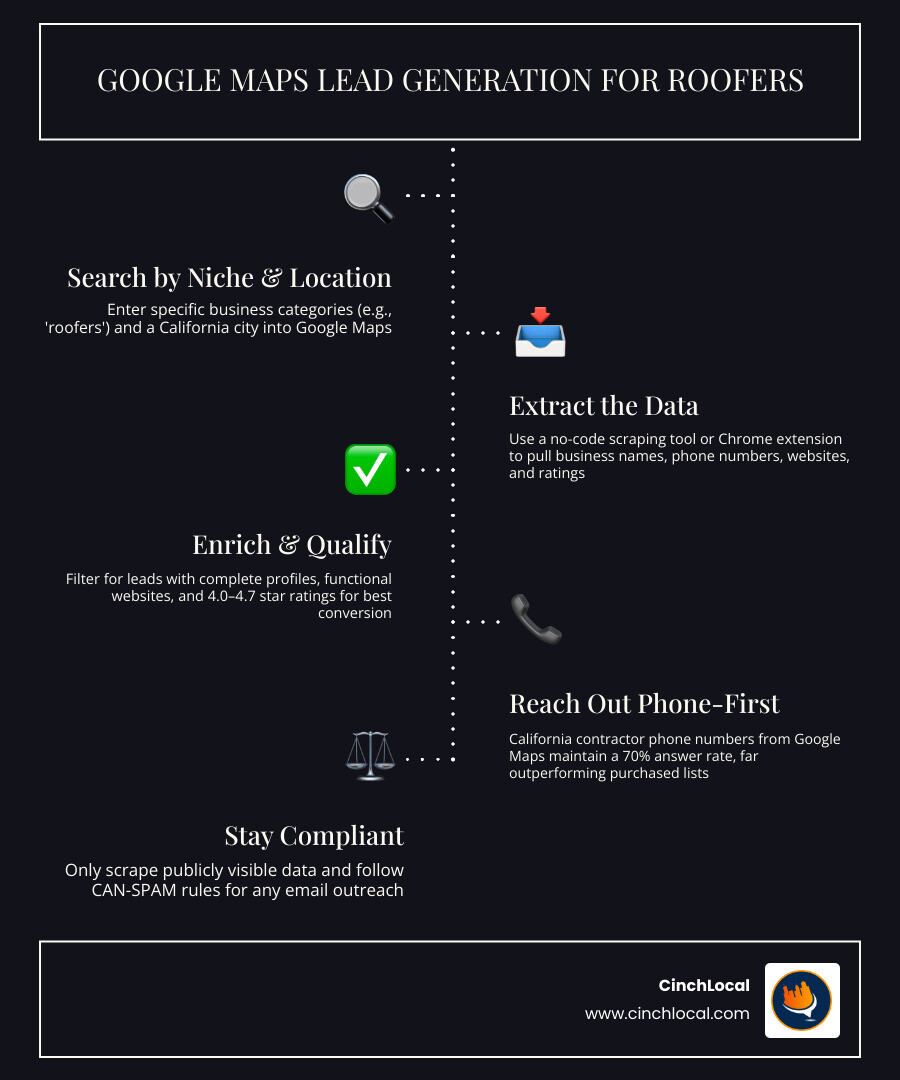
Here's the quick answer on how to find local business leads from Google Maps in California:
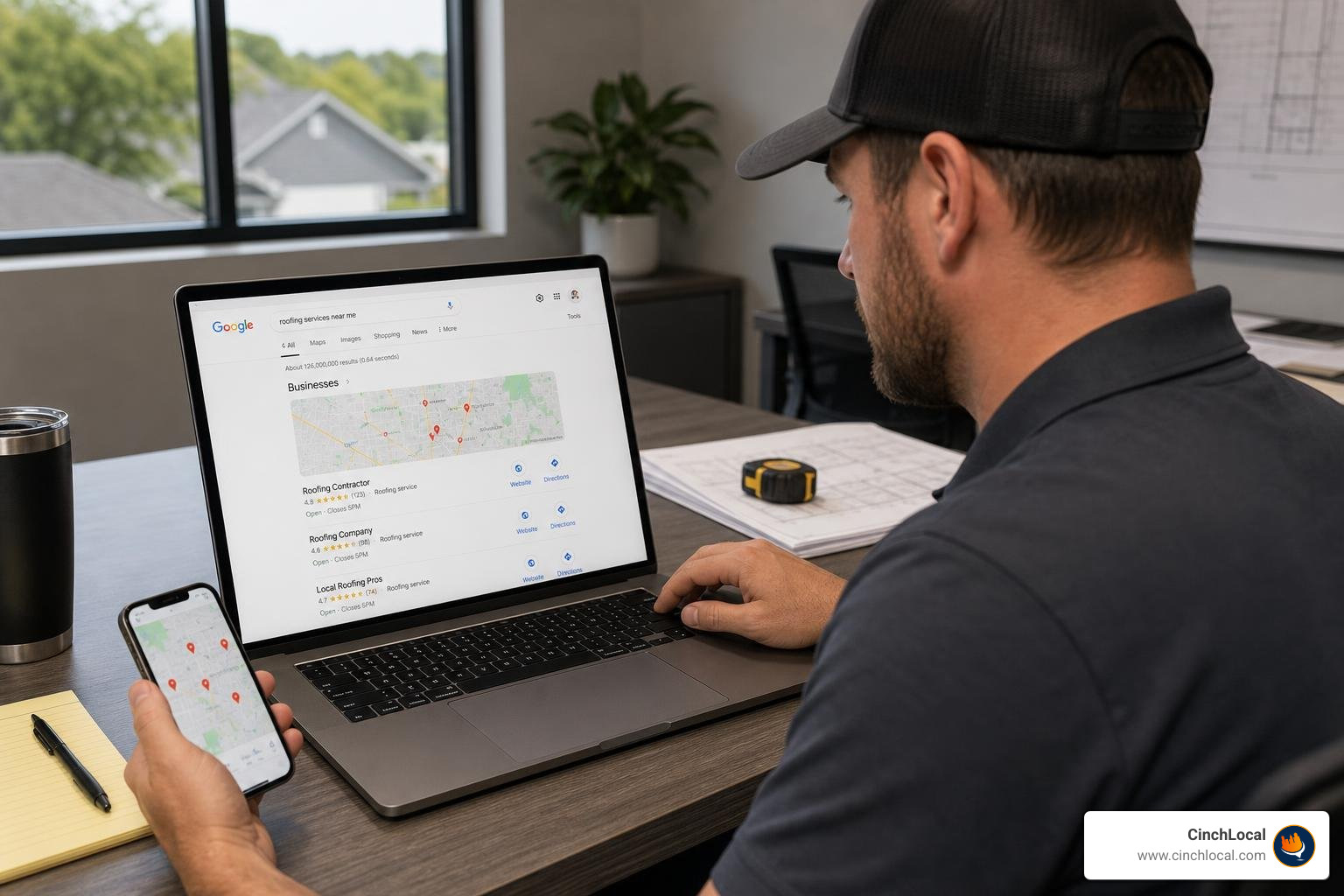
- Search by niche and location — Enter a specific business category (e.g., "roofers") and a California city into Google Maps.
- Extract the data — Use a no-code scraping tool or Chrome extension to pull business names, phone numbers, websites, and ratings.
- Enrich and qualify — Filter for leads with complete profiles, functional websites, and 4.0–4.7 star ratings.
- Reach out phone-first — California contractor phone numbers from Google Maps maintain a 70% answer rate, far outperforming purchased lists.
- Stay compliant — Only scrape publicly visible data and follow CAN-SPAM rules for any email outreach.
Google Maps is not just a navigation tool. It is the single largest, most up-to-date directory of local businesses on the planet — with over 200 million business listings across 220+ countries and 2 billion monthly active users. For a roofing contractor in California, that means your next 50 jobs are already listed there, waiting to be found.
The problem is that most contractors are either leaving that data on the table entirely, or they're manually copy-pasting listings into a spreadsheet one by one — which is slow, error-prone, and frankly unsustainable. To build a truly resilient business, you must combine local data extraction with a comprehensive strategy for roofing marketing that keeps your pipeline full.
This guide walks you through exactly how to extract, enrich, and act on Google Maps leads in California — so you can build a predictable pipeline of high-ticket roofing jobs without paying for stale, oversold lead lists. Once you master local maps, you can scale your reach even further by learning how to implement Meta Ads optimization for roofers to target high-intent homeowners in your service area.
I'm Cary Byrd, CEO and founder of CinchLocal — a roofing marketing agency that has spent years helping contractors dominate Google Maps leads in California and beyond through data-driven local SEO and lead generation strategies. My background building eDrugSearch.com taught me that the businesses that win online are the ones who understand how to find and act on data faster than their competitors — and the same principle applies directly to local roofing lead generation.
The Double-Edged Sword: How Google Maps Leads California Drivers and Businesses Alike
Relying on automated algorithms without manual verification is a dangerous game, whether you are a driver navigating a desert storm or a roofing business owner looking for accurate sales prospects.
To understand how to generate high-quality opportunities, we first need to look at what we can learn from a viral navigation disaster. If you want to bypass these digital traps and set up a reliable flow of customers, you can visit the CinchLocal homepage to see how we build high-converting, localized systems for home service business owners.
Before we dive into the technical side of data extraction, we should review the fundamental steps of local prospecting. If you want a quick primer on the basics, you can Learn how to generate Google Maps leads in 5 easy steps to see how simple the baseline process can be.
To supplement your strategy with cost-effective prospecting tactics, you can also Discover how to get leads from Google Maps, which details manual and extension-based extraction methods that cost absolutely nothing.
Why Google Maps Leads California Travelers Off Course: The Desert Detour Incident
Google Maps misled dozens of California drivers into the Nevada desert during a severe dust storm on November 19, 2023, by prioritizing an unverified, off-road detour over a backed-up interstate.
The incident began when severe weather and dust storms caused massive traffic delays on Interstate 15, which is the primary highway connecting Southern California to Las Vegas. Seeking a way to bypass the gridlock, the Google Maps algorithm suggested an alternative route that promised to be 50 minutes faster.
The consequences for the drivers who trusted the GPS were severe. Instead of a paved highway, the app routed them onto a washed-out, unpaved desert trail near Shelby, Nevada. As the path deteriorated, several vehicles became stuck in the rugged terrain.
The stranded drivers had to wait in the desert until approximately 5:00 PM, when professional tow trucks finally arrived to rescue them. The vehicles sustained significant physical damage; at least one driver reported a misaligned wheel and a tire coming off, resulting in an expensive repair bill at a dealership service center.
The primary lesson for drivers is to never blindly trust digital navigation in unfamiliar, extreme environments. When a GPS app suggests a sketchy detour, drivers should double-check the route on a secondary map, stay on major highways during storms, and keep a physical map as a backup.
What Home Service Businesses Can Learn When Google Maps Leads California Prospects
The core lesson from the desert detour incident is that automated algorithms prioritize mathematical optimization over physical reality, a truth that applies directly to local B2B prospecting.
Just as drivers blindly followed a flawed detour, many sales teams blindly trust static, purchased lead lists that are plagued by data decay. In California, contractor licensing data, phone numbers, and business operations change at a rate of roughly 12% per quarter.
If you are a contractor trying to scale your operations, you can read our guide on mapping your success in the Golden State to learn how to navigate this fast-moving local landscape.
Relying on outdated databases means you are wasting your time calling disconnected numbers and pitching closed businesses. To build an accurate pipeline, you must extract real-time data directly from Google Maps.
According to research on contractor prospecting strategies in California, 92% of top-rated California contractors keep their Google Maps profiles updated with their current phone numbers and website URLs because they cannot afford to lose customers. By scraping Google Maps in real time, you bypass the decay cycle and target active, operational businesses.
The Mechanics of Google Maps Scraping for Roofing Contractors
Google Maps scraping is the automated process of using software to extract public business data from Google Maps listings and saving it into a structured spreadsheet. For B2B sales teams and marketing agencies, this is the most efficient way to build a highly targeted local lead list.
The global web scraping industry crossed $1.03 billion in 2025 and is projected to grow at a compound annual growth rate (CAGR) of 14.2% to reach $2 billion by 2030. This explosive growth is driven by the reality that businesses need fresh, accurate data to feed their sales pipelines and AI-driven marketing systems.
To understand why automated scraping is the superior choice for roofing contractors, let's compare it directly to manual data collection:
| Feature | Manual Lead Extraction | Automated Google Maps Scraping |
|---|---|---|
| Speed | 10–15 leads per hour | 1,000+ leads in under 10 minutes |
| Data Accuracy | High, but prone to human typing errors | 100% match of live Google Maps data |
| Cost | High (measured in hours of labor) | Low (pennies per lead) |
| Enrichment | Extremely slow (requires manual site visits) | Automated (crawls sites for emails and social links) |
| Scalability | Not scalable across multiple cities | Highly scalable across entire states and regions |
To get a detailed, step-by-step breakdown of how to build these lists programmatically, you can read our technical resource on how to build a service-area lead list from Google Maps.
Legal and Ethical Considerations of Map Scraping
Scraping publicly available data from Google Maps is legal in the United States, supported by major legal precedents like the Ninth Circuit ruling in hiQ Labs v. LinkedIn (2022). This ruling established the "public data doctrine," which protects the collection of information that is openly accessible on the internet without a login wall.
However, while the act of scraping is legal, you must comply with regional privacy and outreach regulations:
- CCPA Compliance : Under the California Consumer Privacy Act, you must ensure that any scraped business data is traceable to its public source and that you respect opt-out requests.
- GDPR Compliance : If you are targeting businesses in the EU, you must ensure you have a "legitimate interest" for B2B contact and avoid scraping personal, non-business email addresses.
- CAN-SPAM Act : Any cold email outreach you perform using scraped data must include a clear physical address, an easy unsubscribe link, and non-deceptive subject lines.
- Google's Terms of Service : Google technically prohibits automated scraping on its platform. They enforce this through technical measures like IP blocks and CAPTCHAs rather than legal action. Professional scrapers bypass this by rotating residential proxies and scraping at human-like speeds.
Top Methods and Tools for Extracting Local Leads
There are several methods available for extracting business leads from Google Maps, depending on your technical expertise:
- No-Code Scraping Platforms : Tools like Scrap.io allow non-technical users to select a business category and location, then export a fully enriched CSV file in minutes.
- Chrome Extensions : Lightweight browser extensions like LeadGrab allow you to capture leads locally on your device with a single click, keeping your data private and secure.
- Programmatic Python Scrapers : For developers, using an open-source Google Maps business scraper built with Playwright allows for highly customized, large-scale extractions. These tools can run in "Mega Mode," executing micro-queries across thousands of zip codes to bypass standard search limits.
How to Enrich and Qualify Scraped Leads to Win High-Ticket Roofing Jobs
Raw contact data is only the starting point. To convert Google Maps leads into high-paying commercial or residential roofing contracts, you must enrich and qualify those leads before reaching out.
If you want to understand the foundational strategies that turn local map views into actual revenue, read our guide on local SEO secrets for roofing businesses.
Once you have your initial list, you need to structure your sales process to handle these prospects systematically. To learn how to manage this flow, you can explore how to build a sales pipeline with Google Maps leads, which outlines the journey from initial search to a closed contract.
Identifying Digital Defects to Create High-Converting Outreach Hooks
The secret to a 3-5x higher reply rate on cold outreach is "defect-led qualification." Instead of sending a generic sales pitch, you analyze the scraped data to identify specific digital problems (defects) that the business owner is currently facing:
- No Dedicated Website : Over 40% of small businesses do not have a website. This is an immediate hook to offer a simple, high-converting landing page.
- Slow Page Load Speed : A website that takes longer than 3 seconds to load is losing customers. You can run a quick speed test and present the data as proof.
- Missing SSL Certificate : Websites without HTTPS are flagged as "Not Secure" by browsers, driving away potential clients. Offering a quick security fix is an easy way to build trust.
When you lead your outreach with a specific, verifiable problem that the owner can see in 30 seconds, you position yourself as a helpful expert rather than an annoying salesperson.
Bypassing the 120-Result Viewport Cap
Google Maps enforces a strict limit of approximately 120 results per search query, regardless of how far you scroll or zoom out. If you search for "roofers in Los Angeles," Google will only show you the top 120 listings, hiding thousands of smaller neighborhood operators.
To bypass this limit, you must use a programmatic coordinate grid system or "viewport walking." This technique divides a larger metropolitan area into a grid of overlapping small-radius viewports (or zip codes) and runs a separate micro-search for each cell.
Once the micro-searches are complete, you merge the results and deduplicate them using Google's unique CID (Customer Identification) identifier . This ensures you capture the "long tail" of local businesses without paying for duplicate listings or getting blocked by Google's rate limits.
Dominating Local Search: Turning Map Visibility into Pre-Sold Roofing Leads
While outbound prospecting using scraped Google Maps data is highly effective, the ultimate goal for any roofing contractor is to have high-intent local customers find you first.
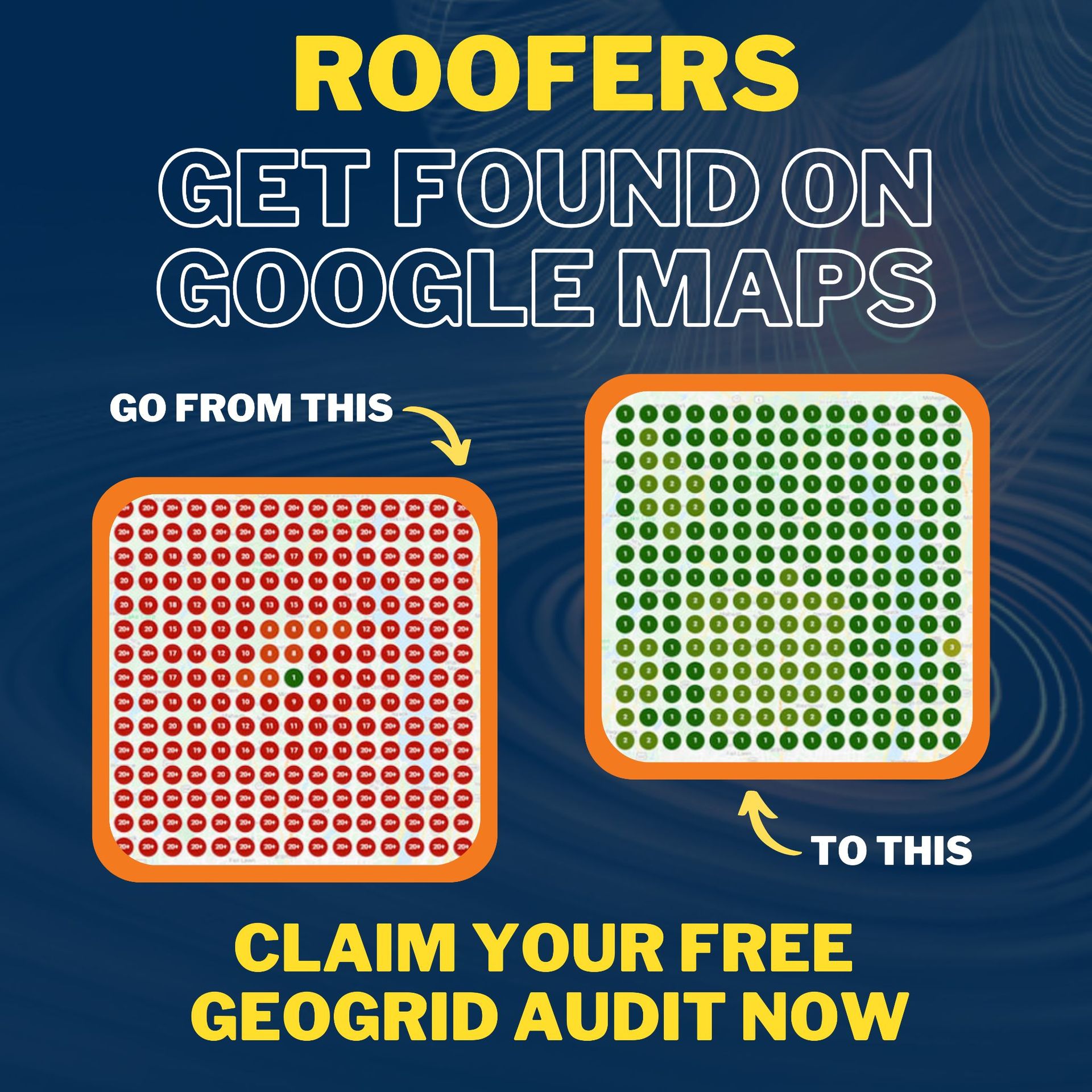
This is where local search engine optimization (SEO) becomes your most powerful business asset. Statistics show that 88% of consumers use Google Maps to find local businesses, and 80% of those local searches turn into a physical visit or phone call within 24 hours. Furthermore, complete and optimized Google Business Profiles receive 7 times more clicks than incomplete ones.
If you are ready to stop chasing leads and start attracting pre-sold commercial and residential roofing jobs, we can help you dominate your local market. For roofing contractors who want a highly specialized, industry-specific local strategy, you can check out our dedicated service page to optimize your Google Maps local SEO for roofers to see how we optimize your digital presence for maximum local reach.
We don't just talk about rankings — we deliver actual, verifiable business growth. To see real-world examples of how we have helped contractors scale their businesses, you can view our proven local SEO results to see our proof of work.
Frequently Asked Questions About Google Maps Lead Generation
Is scraping Google Maps legal for California businesses?
Yes, scraping publicly available business data from Google Maps is legal under US law, supported by the landmark hiQ Labs v. LinkedIn ruling. Because the data is public and does not require a password to access, it falls under the public data doctrine. However, California businesses must ensure their downstream marketing practices comply with the California Consumer Privacy Act (CCPA) and the CAN-SPAM Act.
How do I bypass the 120-result limit on Google Maps?
To bypass Google's 120-result viewport cap, you must divide your target metropolitan area into smaller geographic zones, such as individual zip codes or a grid of coordinate viewports. Running separate micro-searches for each zone and then merging the data using Google's unique CID identifier allows you to extract thousands of unique local listings.
Why is a phone-first approach better for contractor leads?
A phone-first outreach strategy converts 3x better than cold email for local contractors. This is because home service business owners and contractors spend most of their days in the field managing active job sites rather than sitting at a desk checking email. Because they actively answer their phones to capture new customers, you can easily bypass traditional corporate gatekeepers and secure an immediate qualification conversation.
Conclusion
Google Maps is the most powerful, real-time database of local business leads available to roofing contractors today. By moving away from static, outdated directories and embracing automated scraping, enrichment, and local SEO, you can build an exclusive pipeline of high-ticket roofing jobs.
At CinchLocal, we specialize in helping roofing contractors dominate their local markets. Our proprietary Roofer Footprint Expansion System is designed to guarantee increased Google Maps visibility and deliver pre-sold, exclusive leads to your business within 30 days.
If you are ready to stop manually copy-pasting listings and start dominating your local territory, contact us today to set up your customized local marketing strategy. Let us help you put your business on the map and keep your crews busy all year long.
Want Us to Uncover Hidden 'Footprint Gaps' And Critical Blind Spots That’s Quietly Draining Calls, Jobs, and Profits?
Simply Fill Out The Form Below:
What If You Could Stop Wasting $30K+ a Year on Dead-End Marketing - And Finally Become the Go-To Roofer in Your City?
Other Helpful Articles You Might Enjoy