

Where to Find Reliable Slate and Valley Repair Services

Cary Byrd // Founder of CinchLocal
Why Slate Roof Repair Services Demand a Specialist — Not a Generalist
If you need a quick answer: reliable slate roof repair requires a certified specialist who follows National Slate Association standards, uses traditional tools like slate rippers and copper hooks, and avoids shortcuts like face-nailing or sealant patches.
Here's what to look for when finding qualified slate repair services:
| Criteria | What to Look For |
|---|---|
| Standards compliance | Follows 1927 National Slate Association guidelines |
| Fastener materials | Copper or stainless steel nails — not steel |
| Flashing method | Copper or lead flashing, not caulk or sealant |
| Material matching | Maintains inventory of reclaimed and new slate |
| Experience | Slate is their core business, not a sideline |
| Certifications | NSA membership or state historic trust certification |
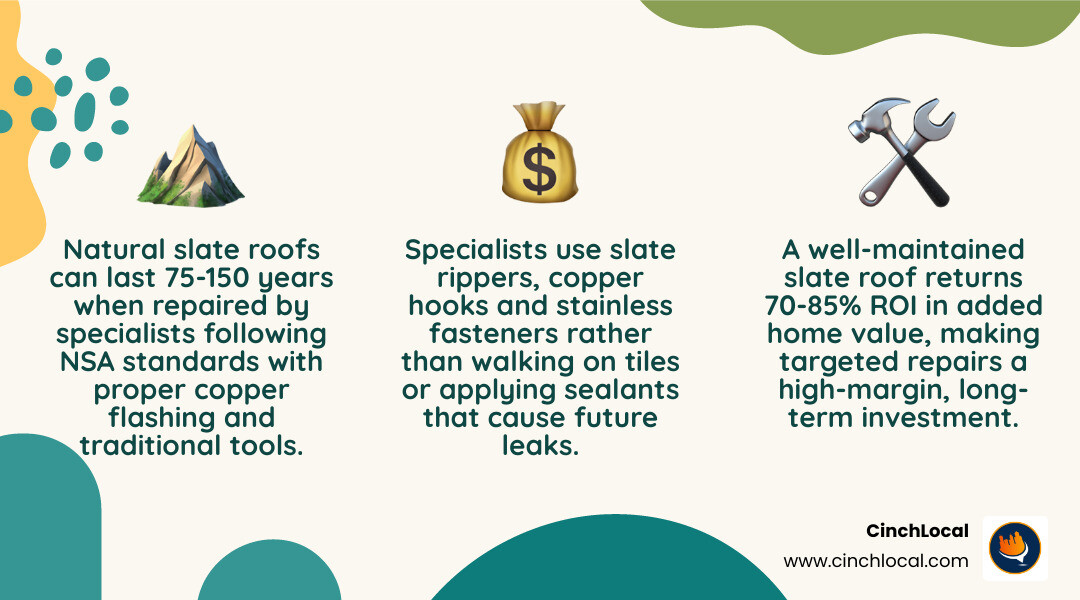
Slate roofs are not like any other roofing system. They can last 75 to 150 years with proper care — and a well-maintained slate roof typically returns 70 to 85% of installation costs in added home value. But that longevity only holds when repairs are done correctly , by people who truly understand the material.
The problem? Most general roofing contractors treat slate like asphalt shingles. Walking directly on the tiles, face-nailing replacements, or applying sealant instead of making mechanical repairs — these shortcuts cause more damage than the original problem. As one industry principle puts it plainly: slate roofing should only be handled by specialists whose core business is slate, not a sideline.
As of May 2026, demand for historic slate restoration is surging across the Northeast, particularly in Pennsylvania, New Jersey, and New York. Homeowners with 80- to 100-year-old roofs are learning that a targeted repair — done right — can extend the life of their roof by decades without a full replacement. That makes this one of the highest-value, highest-margin service categories in residential roofing today.
For roofing contractors looking to grow in this space, partnering with roofing marketing experts who understand the high-ticket nature of stone roofing is just as important as the craftsmanship itself. If you're ready to scale your specialty roofing business, book a strategy session with our team to see how we've helped others dominate this niche.
I'm Cary Byrd, CEO of CinchLocal, and I've spent years helping roofing contractors build the digital presence needed to attract premium slate roof repair services clients who are actively searching for specialists. In this guide, I'll show you exactly where to find — and how to position yourself as — the reliable slate repair expert your market needs.
Simple guide to slate roof repair services :
Identifying Common Issues Requiring Slate Roof Repair Services
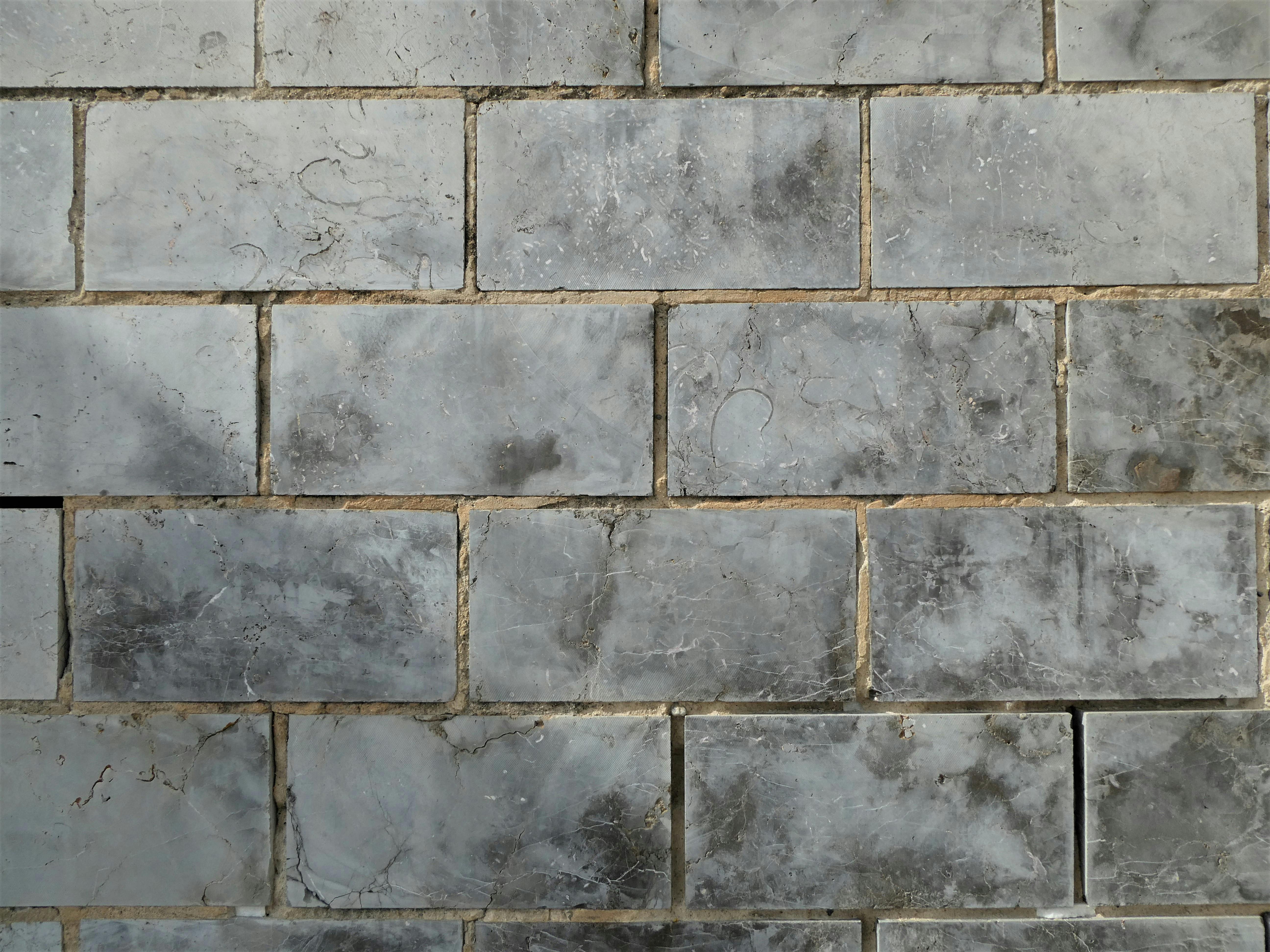
When we evaluate a slate roof, we aren't just looking at the stone; we are looking at the entire assembly. Slate is a natural stone product that is incredibly durable, but it is only as strong as its weakest link. In many cases, the "permanent" stone outlasts the metal and wood components holding it together.
Common issues that trigger the need for slate roof repair services include:
- Cracked or Broken Slate: Often caused by fallen branches, ice dams, or — most frustratingly — inexperienced contractors walking on the roof.
- Slipped Tiles: When a fastener fails, the slate slides out of position, exposing the underlayment.
- Nail Fatigue: This is the silent killer of older roofs. Original steel nails eventually rust through, causing slates to drop.
- Failed Flashing: Valleys, chimneys, and dormers rely on metal flashing (ideally copper). When this metal thins or corrodes, leaks follow.
- Ice Damming: In northern climates like PA and NJ, heavy snow loads can force water under the slates if proper eave protection isn't in place.
For those dealing with recent weather events, our roof repair after hail guide offers specific insights into identifying impact damage on specialty materials. To ensure a repair lasts another century, we always recommend following the 1927 National Slate Association (NSA) Standards, which dictate the use of copper valleys and precise mechanical bonds rather than temporary sealants.
Diagnosing Slipped Tiles and Nail Fatigue in Slate Roof Repair Services
Nail fatigue is perhaps the most common reason for slate roof repair services on homes built 80 to 100 years ago. While the slate itself may still be in excellent condition, the fasteners have reached their expiration date. We often see steel or galvanized nails that have completely corroded, leaving the slate held in place by nothing but friction.
You can spot this by looking for "sliding" slates that sit lower than the surrounding row. If you find slate fragments in your gutters or on the ground after a windstorm, it’s a definitive sign of fastener failure. According to National Park Service preservation standards, visual alignment is the first step in a comprehensive assessment. Replacing these with copper or stainless steel nails ensures the repair won't need to be revisited for another lifetime.
Addressing Valley and Flashing Failures in Slate Roof Repair Services
The "valleys" of a roof — where two slopes meet — carry the highest volume of water. In a slate system, these should be lined with heavy-gauge copper. Over many decades, even copper can wear thin due to the acidic nature of rainwater or debris buildup.
When we see leaks near chimneys or dormers, the culprit is almost always the counter-flashing or the lead soldering at the joints. It is critical to stop the drip with these shingle and flashing fixes using mechanical techniques. A major red flag in slate roof repair services is the use of roofing cement or caulk. These are temporary "band-aids" that crack within a few seasons. A true specialist uses lead-burning or soldering to create a permanent, watertight bond.
Repair vs. Replacement: Evaluating System Integrity
One of the most frequent questions we hear is: "Do I need a new roof, or can this be fixed?" The answer lies in the 20-30% rule. If more than 20-30% of the slates are damaged, delaminating (flaking apart), or "soft," a full replacement may be more cost-effective.
However, because slate is so durable, most issues are localized. We often help contractors present partial roof replacement options for savvy homeowners who want to preserve their historic aesthetic without the $50,000+ price tag of a total tear-off.
Consider these factors during your evaluation:
- Structural Weight: Slate weighs between 800 and 1,000 pounds per square (100 sq. ft.). Any repair must ensure the underlying rafters can still support this load.
- Underlayment: Older roofs used organic felt that eventually turns to dust. During a repair, we look for opportunities to install breathable synthetic underlayment that manages vapor better than traditional materials.
- Slate Grade: Is the roof S1 (75+ years), S2 (40-75 years), or S3 (20-40 years)? Knowing the grade helps determine if the rest of the roof is worth saving.
Determining the Scope of Slate Roof Repair Services vs. Full Replacement
A site assessment should involve more than just a ladder and a pair of eyes. We recommend moisture scanning to see if leaks have compromised the roof deck. If the majority of the tiles are sound but the fasteners are failing, "re-nailing" the roof is a viable middle ground.
While some homeowners might consider switching to modern alternatives, we often point them to the ultimate guide to metal roofing pros and cons to compare longevity. Usually, the historic value and 100-year life of slate win out, provided you can source a matching material. A professional repair plan must account for both visual consistency and performance, which is why we maintain connections with reclaimed slate yards to match the weathered patina of an existing roof.
Specialized Skills and Tools for Professional Restoration
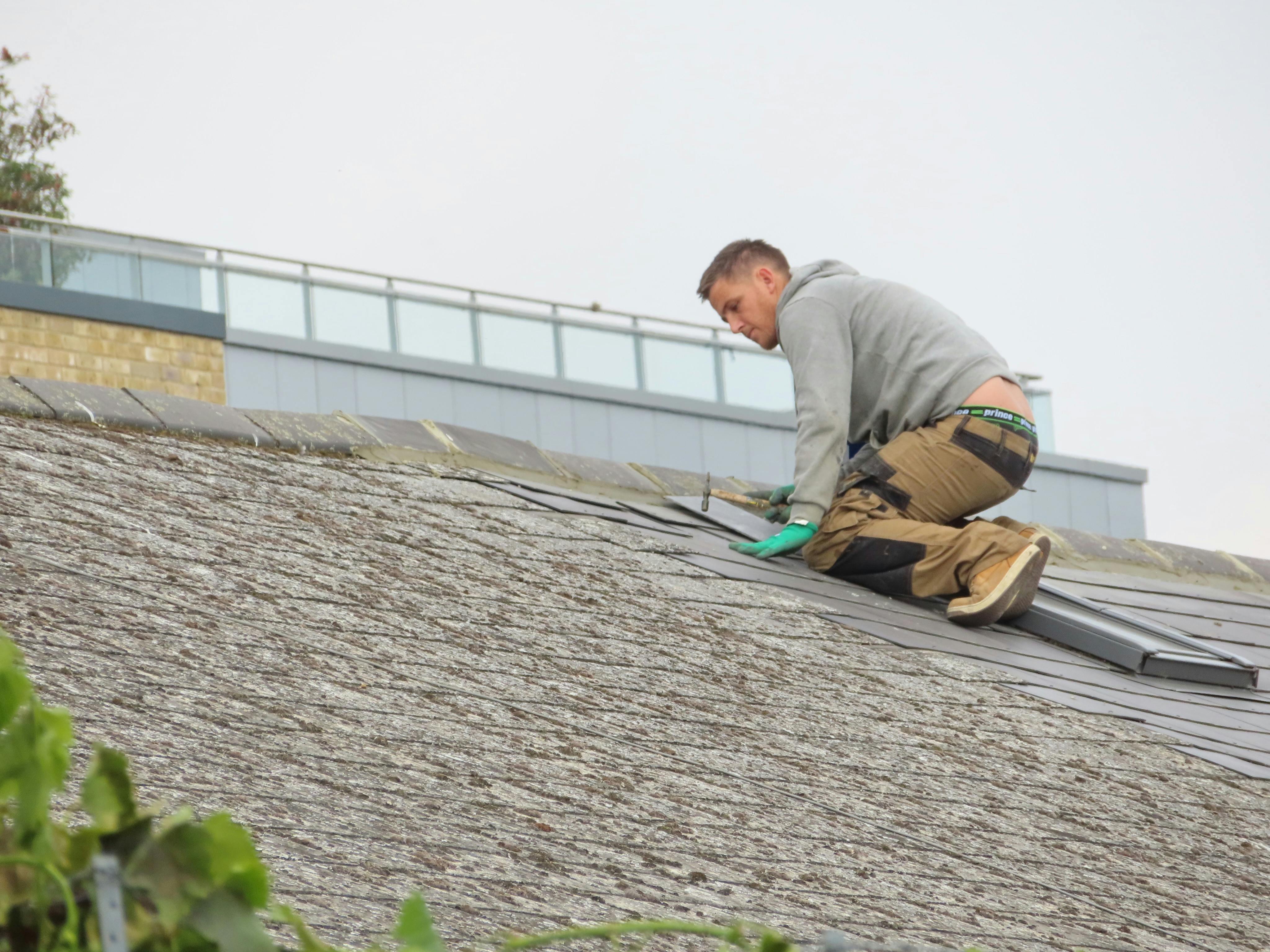
You cannot repair a slate roof with a standard tool belt. If a contractor shows up with just a hammer and a pry bar, send them home. Slate roof repair services require a specific set of "Old World" tools:
- Slate Ripper: A long, flat tool used to slide under a slate and cut the nails without breaking the stone.
- Slate Hammer: Features a pointed end for punching nail holes and a claw for pulling nails.
- Cutting Stake: Used to trim slates to size on-site.
- Copper Hooks: Often used for individual tile replacements where "blind" nailing isn't possible.
One of the most common errors is "face-nailing," where a roofer drives a nail straight through the exposed part of the slate and covers the head with sealant. This is a violation of National Slate Association standards and will eventually fail. Master craftsmanship involves "hanging" the slate so it sheds water naturally, just as it did when originally installed.
Technical Differences Between Slate and Asphalt Repairs
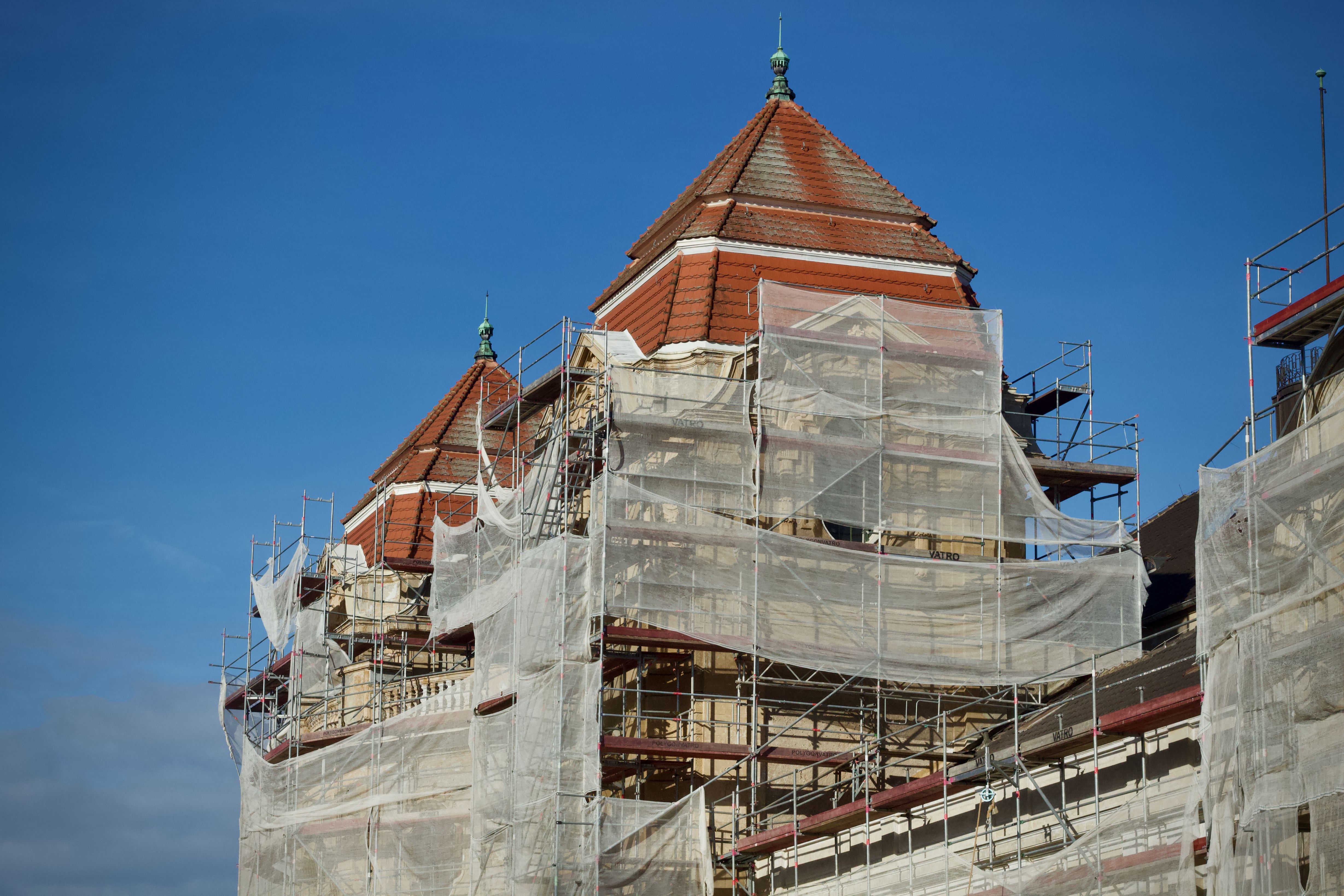
Slate repair is a "non-walkable" trade. Unlike asphalt, where you can walk freely, walking on slate will crack the tiles. Specialists use hook ladders, roof brackets, and scaffolding to perform work without ever putting weight on the slates themselves.
| Feature | Asphalt Shingle Repair | Slate Roof Repair |
|---|---|---|
| Walking on Surface | Generally acceptable | Strictly forbidden (requires ladders) |
| Tool Set | Utility knife, hammer | Ripper, hammer, stake, punch |
| Fastening | Direct nailing | Hanging (must not over-drive nails) |
| Material Sourcing | Local hardware store | Specialized quarries or reclaimed yards |
| Lifespan of Fix | 10-15 years | 50-100 years |
We also see a major difference in material sourcing. While you can find shingles anywhere, matching a 100-year-old "Sea Green" or "Vermont Black" slate requires a deep inventory. If you are interested in how these methods differ from other specialty systems, see the complete guide to multi-ply rubber roofing for a comparison of flat-roofing techniques often found on slate-roofed additions.
Regional Considerations for PA, NJ, and NY Markets
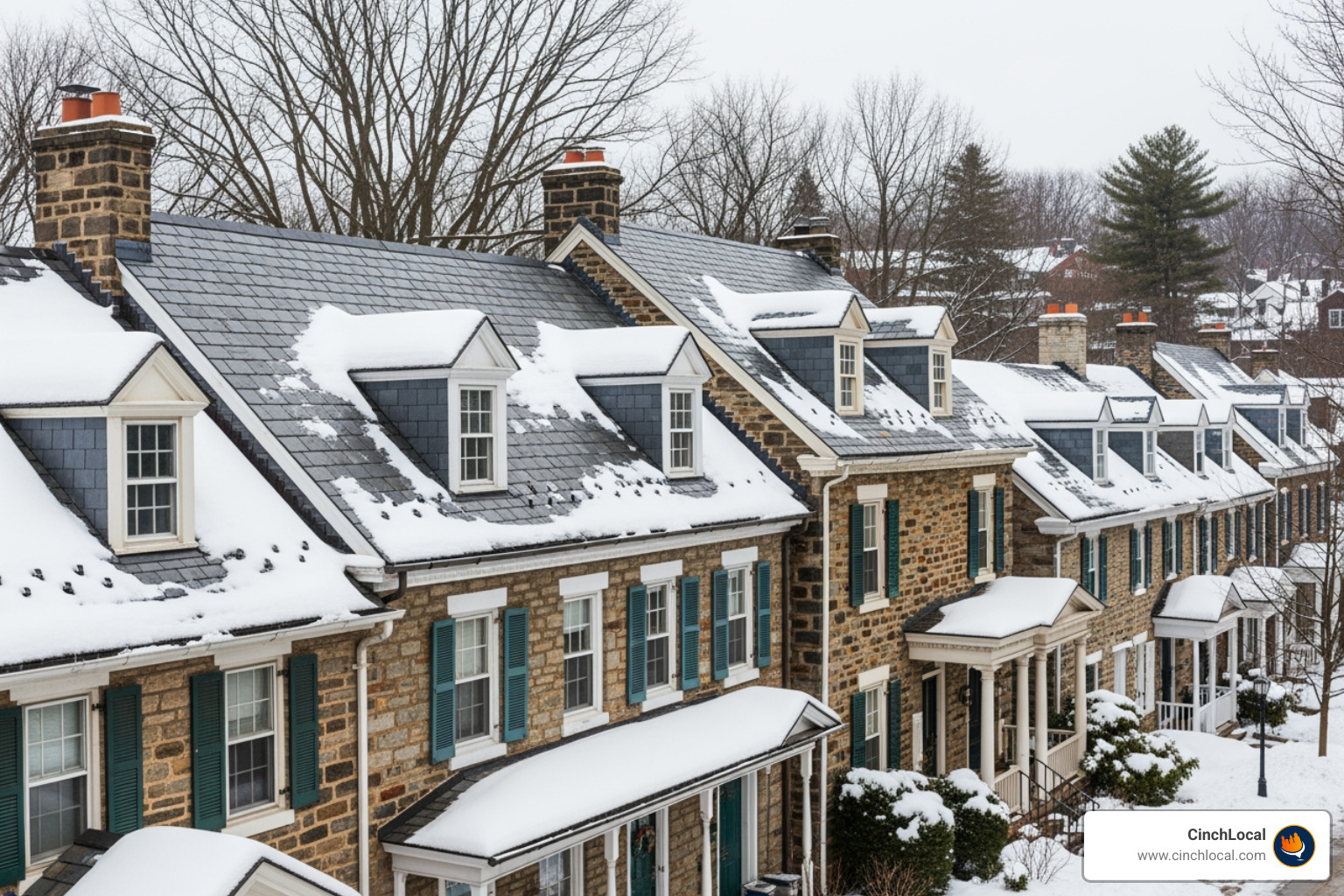
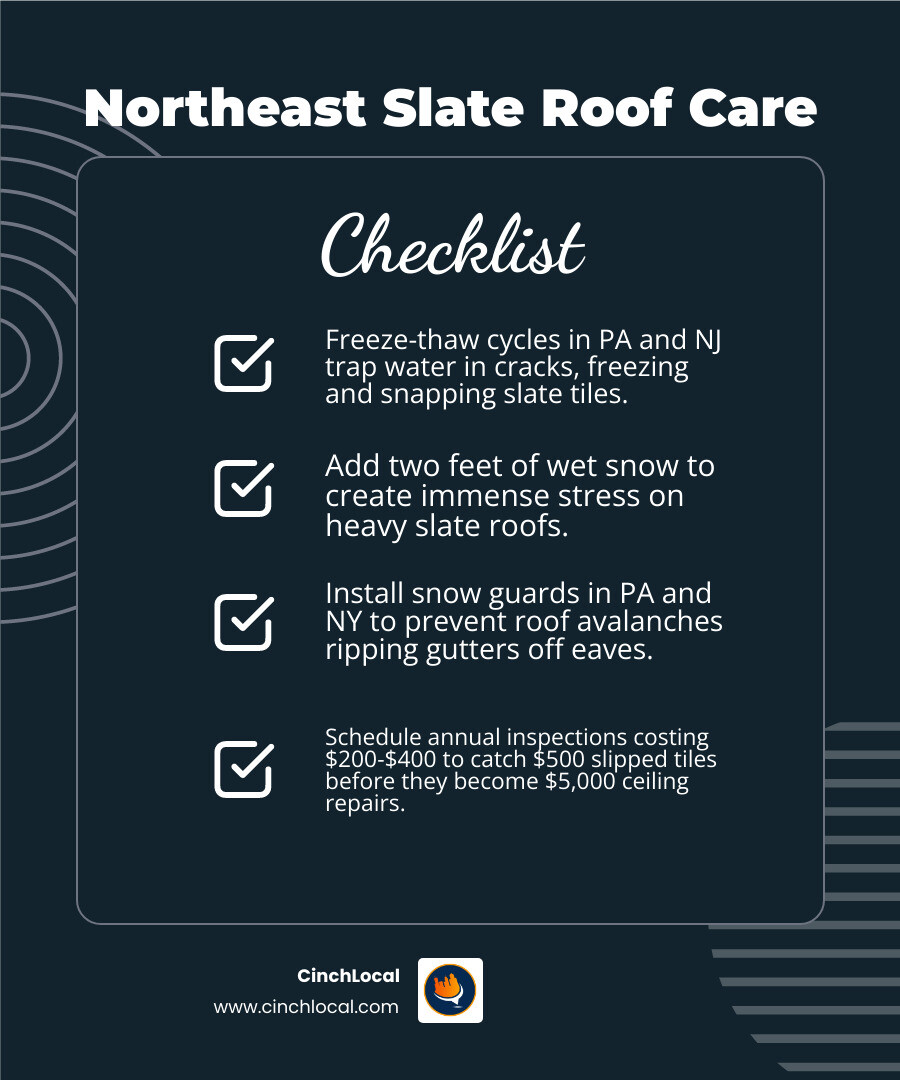
In the Northeast, the climate is the primary enemy of stone roofing. The freeze-thaw cycles in Pennsylvania and New Jersey are particularly brutal. Water gets trapped in small cracks, freezes, expands, and snaps the slate.
Regional specifics include:
- Snow Loads: Slate is heavy; add two feet of wet snow, and your structure is under immense stress.
- Snow Guards: Essential in PA and NY to prevent "roof avalanches" that can rip gutters off the eaves.
- Yankee Gutters: Common in historic NJ and NY homes, these built-in gutters require specialized copper lining and masonry work.
- Historic Districts: Many areas require NJ Historic Trust or local board approval for repairs to ensure the character of the neighborhood is preserved.
According to historic preservation guidelines for the Northeast, many roofs in neighborhoods like Shadyside or Squirrel Hill are over a century old. We recommend annual maintenance contracts for these homeowners. A $200-$400 annual inspection can catch a $500 slipped tile before it turns into a $5,000 interior ceiling repair.
Growing Your Business with High-Value Slate Projects
For the roofing contractor, slate roof repair services represent the pinnacle of the trade. These are high-ticket, high-margin projects that attract a specific type of clientele — homeowners who value quality over the lowest bid.
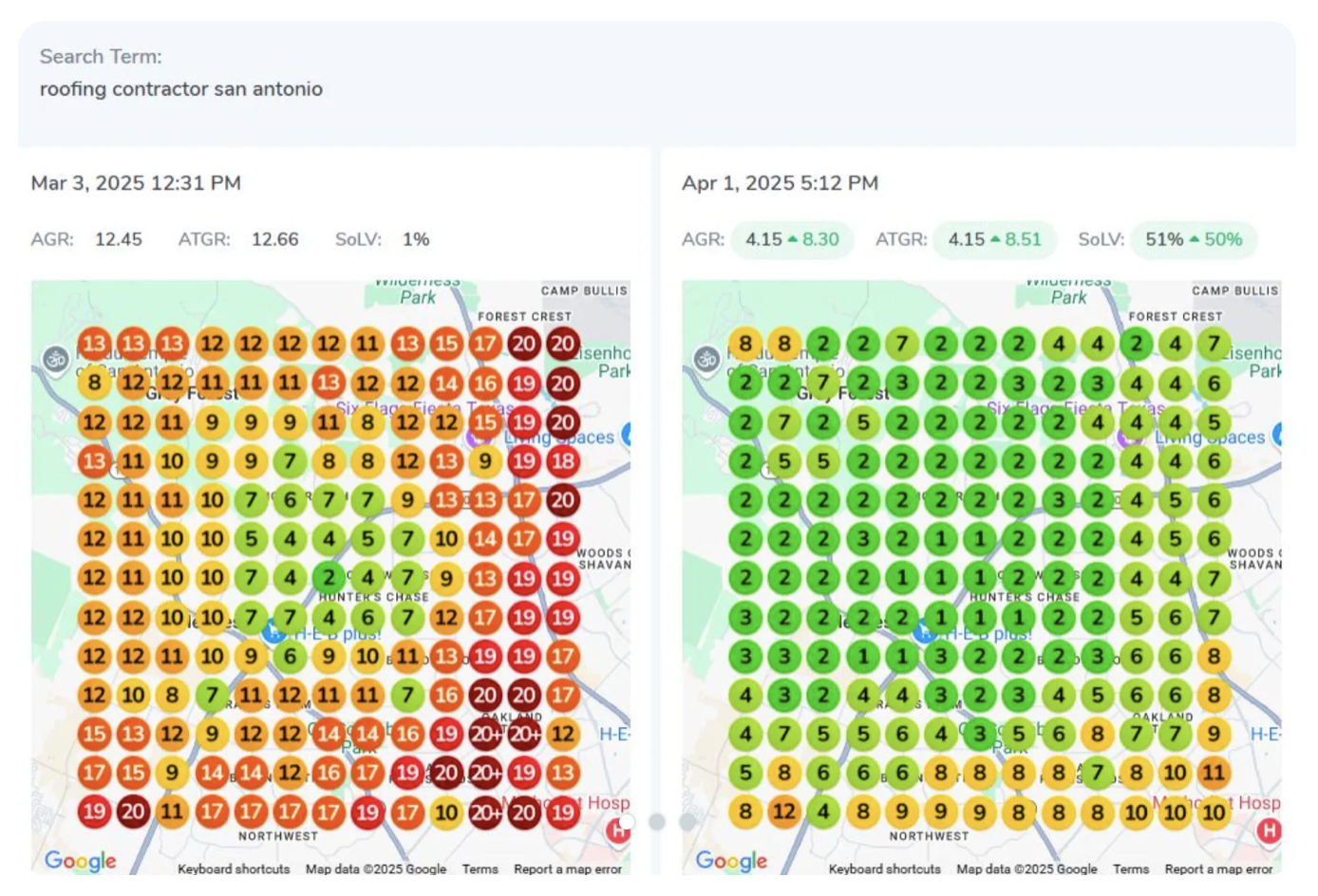
However, finding these leads isn't about traditional "storm chasing." It requires a sophisticated digital presence. At CinchLocal, we use our Roofer Footprint Expansion System to help specialists dominate their local markets. By focusing on Google Maps local SEO for roofers, we ensure that when a homeowner in a historic district searches for "specialized slate repair," your business is the first one they see. We provide the "proof in the pudding" through our results page, showing how we've helped contractors secure pre-sold leads.
Our system uses geotagged job pins and reputation management to showcase your expert craftsmanship on the very streets where your target customers live. We guarantee increased visibility within 30 days, allowing you to stop competing on price and start winning on expertise. If you are ready to stop chasing low-margin repairs and start winning premium restoration contracts, contact us today to see our proven results.
Frequently Asked Questions about Slate Roof Repair
How long does a typical slate roof repair take?
Most standard repairs involving 10-15 tiles and minor flashing adjustments are completed within one business day. Complex valley replacements or projects requiring historical matching of rare slate colors may extend to 48-72 hours, depending on material availability and the setup required for steep-slope safety.
What is the typical cost range for slate repair?
While a full $30,000 installation averages out to just $300 per year over its long life, individual repair visits typically range from $500 to $2,500. Factors affecting the price include the height and pitch of the roof, the number of slates being replaced, and whether custom copper fabrication is needed for valleys or chimneys.
Can any roofing contractor repair a slate roof?
Absolutely not. Slate is a natural stone that requires specialized tools like rippers, hammers, and stakes. General contractors often cause more damage by walking directly on the tiles, which creates internal fractures, or by using improper face-nailing techniques that lead to future leaks. Always hire a specialist who lists slate as their core business.
Conclusion
Slate roofing remains the gold standard for durability as of May 2026, offering a century of protection when maintained by specialists. Whether you are a homeowner looking to preserve a historic treasure or a contractor aiming to dominate a high-margin niche, the key is a commitment to "Old World" standards.
Reliable slate roof repair services are about more than just stopping a leak; they are about honoring the architectural integrity of the home. For roofing contractors looking to grow in this space, CinchLocal provides the digital infrastructure to capture premium leads and showcase your expert craftsmanship. Don't let your expertise go unnoticed — let us help you reach the homeowners who are looking for the best in the business.
Ready to dominate the high-ticket roofing market? Contact CinchLocal today for a free consultation on our Roofer Footprint Expansion System.
Want Us to Uncover Hidden 'Footprint Gaps' And Critical Blind Spots That’s Quietly Draining Calls, Jobs, and Profits?
Simply Fill Out The Form Below:
What If You Could Stop Wasting $30K+ a Year on Dead-End Marketing - And Finally Become the Go-To Roofer in Your City?
Other Helpful Articles You Might Enjoy